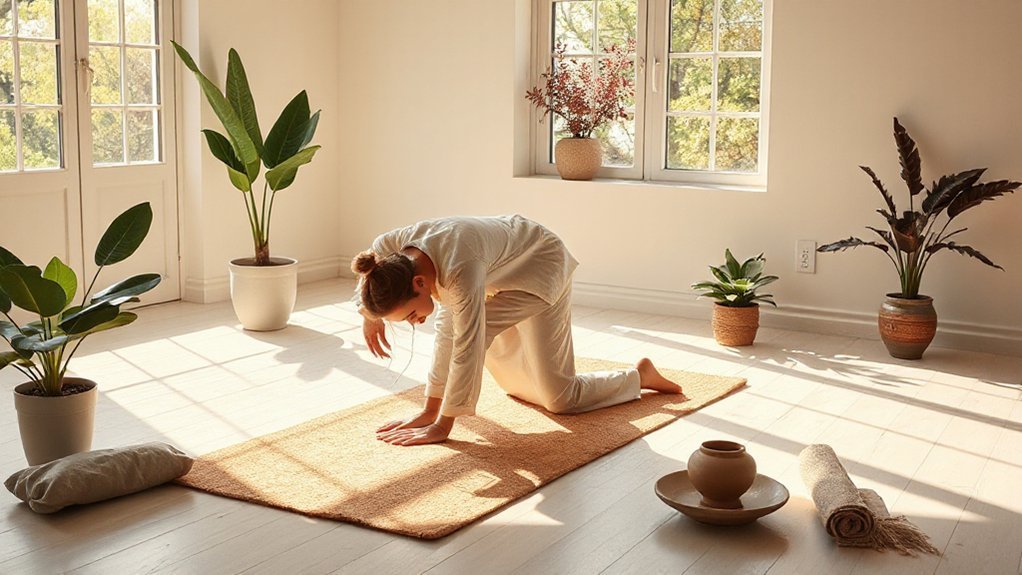

You’ve got ten minutes—that’s all you need to rewire your nervous system from chaos to calm. Start with Child’s Pose, Happy Baby, Cat–Cow, Cobra, and Chair, holding each for sixty seconds. Sync your breath with movement: inhale to open, exhale to fold. No equipment needed, no perfection required. The magic isn’t in nailing every pose; it’s showing up consistently, same time and place. Anchor your practice to a daily trigger—coffee, sunlight, a lit candle—and watch how this small ritual compounds into sharper focus, easier movement, and genuine strength throughout your day. Stick with five consecutive days, and you’ll discover exactly how to scale your routine to match whatever energy you’re bringing.
Key Takeaways
- Start with ten minutes daily, anchored to the same time and place, to build a sustainable morning yoga habit.
- Practice five foundational poses—Child’s Pose, Happy Baby, Cat–Cow, Cobra, Chair—holding each for 60 seconds as a complete warm-up.
- Sync breath with movement: inhale to open, exhale to fold, automatically regulating intensity and calming your nervous system.
- Scale session length to match energy levels—ten minutes when tired, twenty to thirty when rested—prioritizing consistency over perfection.
- Create a dedicated six-by-six-foot space with visible mat and props within reach to eliminate friction and support habit formation.
Why Morning Yoga Sets the Tone for Your Whole Day?

Before your feet hit the ground and your phone buzzes with notifications, you’ve got a choice—rush into the day frazzled, or carve out even ten minutes on your mat to shift everything. That brief window rewires your entire morning.
Before your feet hit the ground, choose calm over chaos—ten minutes on your mat rewires your entire morning.
When you combine gentle movement with intentional breathing, you’re not just stretching muscles; you’re signaling your nervous system to settle down. Your body wakes up calm instead of jolted. Breath-synchronized poses—inhaling as you lengthen, exhaling as you ground—boost natural energy while sharpening mental clarity for the tasks ahead.
Here’s the thing: morning stiffness dissolves fast. Hip openers and spine mobilization tackle that post-sleep discomfort, so you move through commutes and workouts with ease, not resistance.
Starting with just ten minutes builds momentum. Consistency compounds. Over time, you’re not just feeling better in that moment—you’re lowering inflammation, supporting your immune system, and training your mind to show up present instead of reactive.
Your whole day follows suit.
Your First 5-Minute Sequence
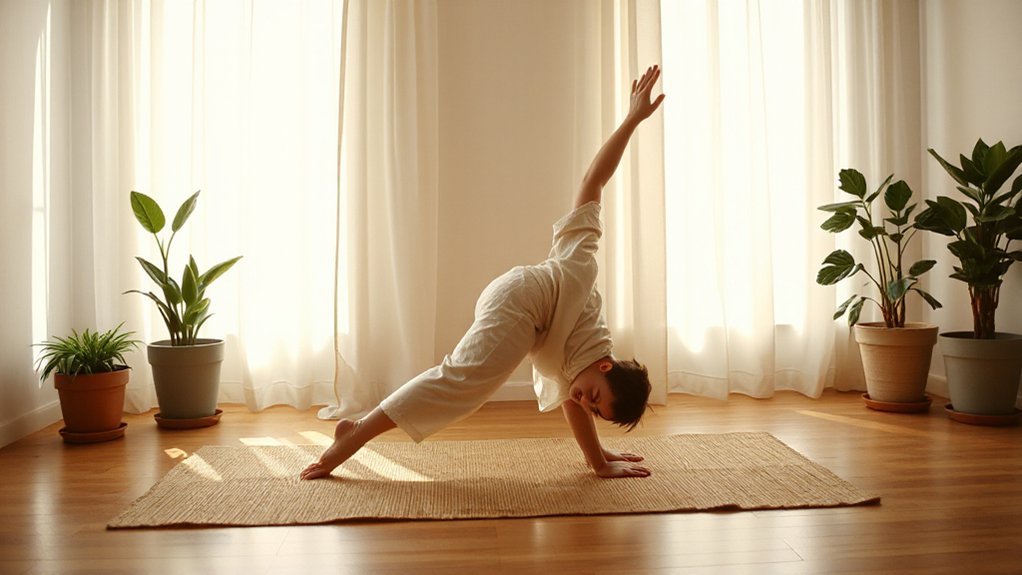
You’re ready to start—and here’s the thing: you don’t need complicated poses or fancy equipment to build a real yoga habit. This five-minute sequence gives you exactly what you need: five foundational poses (Child’s Pose, Happy Baby, Cat–Cow, Cobra, and Chair) that you’ll hold for 60 seconds each, creating a complete warm-up that touches every part of your body from your breath to your legs. The beauty? Once you nail these basics through consistent practice, you’ll have a solid foundation that keeps you showing up, day after day, because it works and it fits into your actual life.
Getting Started With Basics
When you’re ready to actually move your body and wake it up properly, a straightforward five-minute sequence is your best friend—no complicated flows, no hour-long commitments, just five essential poses that’ll loosen you up and get your energy flowing. Hold each pose for 60 seconds, moving deliberately through Child’s Pose, Happy Baby, Cat–Cow, Cobra, and Chair. You’ll reconnect with your breath in Child’s Pose, release hip tension in Happy Baby, warm your spine through Cat–Cow’s rhythm, gently strengthen your back with Cobra, and build leg power in Chair. This sequence costs you nothing but time you’re already spending—might as well use it intentionally. Five minutes. Five poses. Total transformation.
Building Your Daily Habit
The magic isn’t in the poses themselves—it’s in showing up, same time, same place, day after day. Pick a time that sticks: right after waking, before coffee, whatever anchors your day. Your body craves consistency, and your brain rewards it.
Start with your five-pose circuit—Child’s Pose, Happy Baby, Cat–Cow, Cobra, Chair—holding each sixty seconds. Five minutes. That’s it. Grab a blanket or block for support; practice beside your bed if that’s easiest. Modifications aren’t cheating; they’re permission to actually do this.
Pair your routine with something pleasurable: a favorite playlist, tea, that perfect playlist. Track days on a calendar—seeing those checkmarks compounds motivation fast. Once five consecutive days feel natural, you’ll add time naturally. Consistency builds momentum. Momentum builds real change.
Progress to Intermediate Strength and Balance
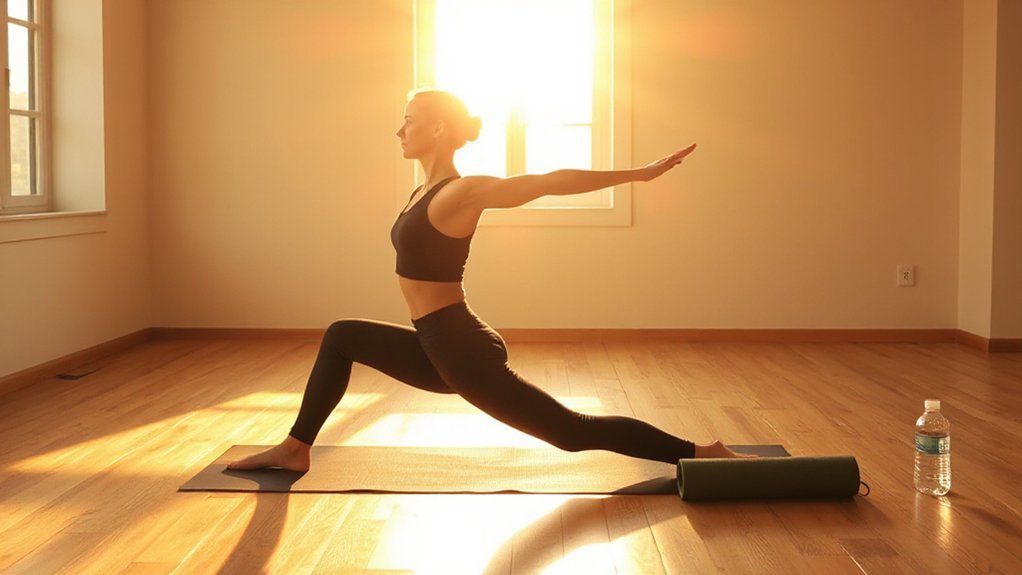
Once you’ve nailed the basics—those gentle Cat-Cows and Child’s Poses that feel almost boring now—it’s time to build real strength and balance into your morning practice. Start with a quick 2–3 minute warm-up using those foundational moves, then jump into your circuit: hold Downward Dog, Warrior I, Bridge, Garland, Bow, and Boat for one full minute each. Repeat the whole thing twice for serious results.
Here’s where it gets interesting: add Vasisthasana (Side Plank) and single-leg variations. These target your core, obliques, and gluteus medius while sharpening your balance and body awareness. Progress gradually—begin with one circuit round, then build to two. Or stretch individual holds from 30 seconds up to 60 seconds. The secret? Sync your breath with movement. Inhale to lengthen and open; exhale to contract and ground. This breathing pattern stabilizes everything, making those challenging poses feel more controlled and accessible. You’re not just holding poses—you’re building functional strength that carries you through your entire day.
Master Advanced Poses
You’ve built solid strength and balance—your body’s ready for what comes next.
Now tackle advanced poses with intention. Start with prerequisite drills: spend 3–5 minutes on core work, shoulder openers, and hip openers before attempting full expressions. Think King Pigeon or arm balances—they demand respect and preparation.
Warm up thoroughly. Ten to fifteen minutes warming your spine, shoulders, and hips through Cat–Cow, Downward Dog, lunges, and Bridge prevents injury. Cold attempts at advanced backbends? That’s how you wreck progress.
Progress gradually: move from 10–20 second partial variations toward full 45–60 second holds across 3–5 sets. Rest between attempts. Use alignment cues—front knee tracks over your second toe, back hip squared, foot reaches hand with pelvis grounded—to catch compensatory strain before it happens.
Add weekly targeted strength: 2–3 sessions hitting posterior chain, rotator cuff, core. Consider working with a qualified teacher or spotter. You’re not rushing anymore; you’re refining.
Adapt Your Routine to Your Energy
Not every morning feels the same—and that’s exactly the point. Your energy dictates everything: the length, the intensity, the poses you choose.
Waking groggy? Stick to ten minutes. Five poses, held for sixty seconds each, focusing on gentle stretches and breathwork instead of strength work. Your nervous system needs coaxing, not demands.
Higher energy? Expand to twenty or thirty minutes. Layer in intermediate flows—repeat that one-minute circuit twice—and tackle strengthening poses like Chair, Warrior I, and Downward Dog. You’ve got fuel; use it wisely.
Before diving deeper, warm up with two to three minutes of Cat-Cow and gentle Sun Salutations if you’re feeling stiff. This primes circulation safely.
Here’s the real secret: match your breath to movement. Inhale as you lengthen and open; exhale as you fold and contract. This rhythm regulates intensity automatically, preventing burnout regardless of routine length.
Modify constantly. Blanket under hips? Blocks for forward folds? Knee down in Lizard? Do it. Sustainability beats perfection every single time.
Make Morning Yoga a Habit That Sticks
You’ve got to start small—really small, like ten minutes—because that’s what actually sticks around instead of fizzling out after two weeks. Then, here’s the thing: anchor that practice right into something you’re already doing, maybe right after you brush your teeth, so your brain doesn’t have to negotiate whether yoga’s happening today. Finally, claim a little corner that’s yours—throw down a mat, grab a blanket, maybe park a chair nearby—because when your space is ready and waiting, you’re way more likely to actually show up.
Start Small and Consistent
Because habits stick when they’re small and doable, starting with just 10 minutes a day is your secret weapon—way easier to sustain than jumping into hour-long sessions that burn you out by week two. You’re building capacity gradually: 10 minutes becomes 20, then 30 over several weeks. This slow climb prevents burnout while strengthening your commitment.
Here’s the real move: stay flexible. On mornings when you’re dragging, do 10 minutes. When you’re rested and energized, stretch it to 20. That adaptability keeps you showing up consistently, which matters way more than perfection.
Make it accessible too. Practice anywhere—your bedroom, a park, your living room. Grab a cushion, pour your coffee, roll out your mat. Remove friction, remove excuses. Your future self will thank you for making this ridiculously doable.
Design Your Dedicated Space
Clear a 6-by-6-foot area—enough for your mat plus movement. Keep it permanent. No shifting furniture. Next, chase natural light. Position yourself facing east if you can, letting morning sun wake you gently. Aim for 68–72°F; comfort matters.
Here’s the real magic: leave your mat unrolled. Visible. Rolled mats hide in corners and get forgotten. Store your props—block, strap, blanket—within arm’s reach. Remove friction, reduce excuses.
Create a ritual cue. Light a candle. Brew tea. Something small that whispers, “This is yoga time.” Your brain learns the signal.
You’re not building perfection. You’re building inevitability.
Frequently Asked Questions
What Should I Eat Before Doing Morning Yoga on an Empty Stomach?
You’ll want something light, really—nothing heavy sitting in your stomach. Try a banana with almond butter, a handful of berries, or toast with honey. Give yourself 20-30 minutes before you start. If you’re genuinely starving, you’re not doing yourself favors; you’ll be distracted, shaky. A small snack fuels your practice without making you uncomfortable during downward dog. Listen to your body—it’ll tell you what it needs.
How Long Does It Take to See Physical Results From Consistent Morning Yoga?
You’ll notice flexibility gains within two weeks—your body’s practically begging for it. Real strength changes? Three to four weeks. But here’s the honest truth: consistency beats perfection. You’re building neuromuscular connections, strengthening stabilizer muscles, improving posture. Most practitioners see visible toning, better balance, and increased endurance by week six. Stick with it, though. Your transformation’s cumulative.
Can I Do Yoga Immediately After Waking up or Should I Wait?
You can absolutely roll out of bed and onto your mat—your body’s actually primed for gentle stretching right then. But here’s the thing: give yourself five to ten minutes first. Drink some water, let your spine wake up, maybe move around a bit. Your muscles are tight from sleep, so easing in prevents injury. You’ll also focus better once you’re slightly alert. Listen to your body; it’ll tell you what it needs.
What Type of Yoga Mat Is Best for Morning Practice Routines?
You’ve got to feel grounded before you even hit downward dog. Choose a thick, cushioned mat—at least 6mm—that’ll cradle your joints during those early-morning stretches. Look for non-slip surfaces; you’re groggy, not graceful. Eco-friendly rubber or TPE materials work beautifully, breathe well, and won’t off-gas weird smells into your fresh morning air. Honestly, invest in quality here. Your knees’ll thank you.
Is Morning Yoga Suitable for People With Existing Injuries or Joint Pain?
You can absolutely practice morning yoga with injuries or joint pain—just modify smartly. Work with your body, not against it. Skip high-impact poses, focus on gentle stretches and breathing instead. Consider consulting your doctor or a physical therapist first. They’ll guide you toward poses that strengthen without aggravating existing issues. Honestly, morning yoga done carefully can actually improve mobility and reduce discomfort over time.
So
You’ve built your morning yoga practice like a house—foundation first, walls steady, roof secure. Now you’re standing inside, stronger and grounded. You’re not chasing perfection; you’re chasing consistency. Roll out that mat tomorrow, and the next day, because these five minutes you’ve carved out? They’re yours. They’re powerful. They’re the difference between reacting to your day and commanding it.







Leave a Comment