
Your ultimate morning yoga routine starts simple: spend 1–2 minutes centering with breathwork, flow through 5–6 minutes of dynamic poses like Sun Salutations and lunges, then close with 2–3 minutes of restorative stretches. That’s it—10 minutes, anchored right after brushing your teeth, zero excuses. Adjust intensity based on your energy: tired? gentle holds. Rested? repeat circuits. The real magic happens when you meet your body exactly where it is today, skip the perfectionism, and build momentum through small daily wins rather than heroic burnout sessions. Stick around to discover how each phase works together.
Key Takeaways
- Start with 1–2 minutes of seated breathing and gentle Cat–Cow to center and warm your spine.
- Flow through dynamic poses like Sun Salutations and Warriors for 5–6 minutes, syncing movement with breath.
- Finish with 2–3 minutes of restorative poses such as Child’s Pose and forward folds to cool down.
- Anchor your practice to an existing habit—like right after brushing teeth—to build consistency without friction.
- Adjust duration and intensity based on energy levels: 5–10 minutes on low-energy days, up to 20 minutes when rested.
Build Your 10-Minute Morning Yoga Routine
Building a sustainable morning yoga habit doesn’t require an hour of downward dogs and warrior poses—it requires commitment to ten minutes and a smart structure. Here’s what works: organize your practice into three phases.
Start with 1–2 minutes of seated centering. Breathwork and gentle seated cat-cow movements calm your nervous system before moving. Next, spend 5–6 minutes flowing through dynamic poses—sun salutations, lunges, warrior variations—synchronized with your breath. This builds heat and energy.
Close with 2–3 minutes of restoration: child’s pose, forward fold, supine twist. These cool you down and deepen flexibility.
Choose 6–8 poses total, or run through 2 short circuits. Hold static poses 30–60 seconds, or flow through movements naturally. The key? Keeping it simple enough that you’ll actually show up tomorrow, and the next day, and the day after that.
Customize Your Practice Based on How You Feel
How’s your body actually feeling today? That answer matters more than any rigid routine ever could.
Your body’s wisdom matters more than any preset routine—meet yourself where you genuinely are today.
Your practice isn’t one-size-fits-all, so meet yourself where you genuinely are:
- Low energy days: Shorten to 5–10 minutes and sink into gentle holds—Child’s Pose, Happy Baby—for about 60 seconds each. Let your breath lead, not ambition. You’re reconnecting, not proving anything.
- Rested or energetic days: Expand to 10–20 minutes with dynamic moves like Sun Salutations, Downward Dog, and Warrior I. Hold key poses around 60 seconds, repeat circuits for added challenge, and actually feel your strength building.
- Pain or stress days: Prioritize restorative poses with slow, mindful breathing. Skip deep backbends if your lower back’s screaming. Long exhales calm your nervous system when anxiety creeps in.
Start small—10 minutes daily sticks better than ambitious 30-minute sessions you’ll abandon. Adjust your total time to match your energy, choosing gentler or more strength-focused poses accordingly. Your yoga works hardest when it honors how you’re actually feeling.
Progress to Intermediate Poses When Ready
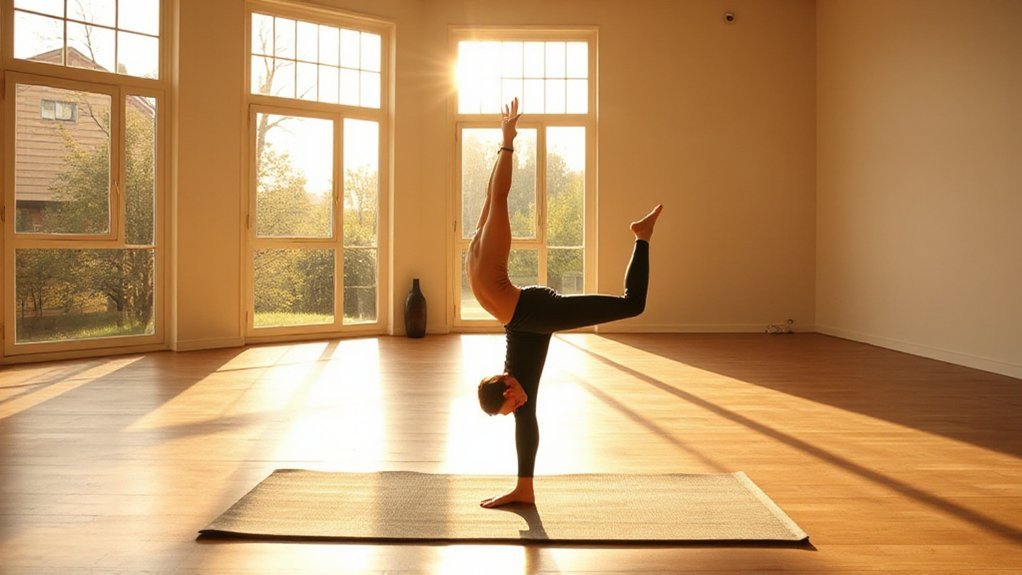
Once you’ve nailed your 10-minute daily beginner practice—holding poses with steady alignment, breathing smoothly, zero pain—you’re ready to level up. Here’s the thing: intermediate work demands respect. You’ll build serious strength, but you’ve got to earn it.
Start smart. Spend 2–3 minutes warming up with Child’s Pose, Cat–Cow, and Happy Baby. Your spine, hips, and shoulders need that prep work—no shortcuts. Then move through a circuit twice: Downward Dog, Warrior I, Bridge, Garland, Bow, and Boat. Hold each pose for about 60 seconds.
| Phase | Duration | Key Focus |
|---|---|---|
| Warm-up | 2–3 min | Mobility prep |
| Circuit 1 | 6 min | Foundation strength |
| Circuit 2 | 6 min | Endurance building |
| Cool-down | 2–3 min | Recovery |
Listen to your breath. Maintain smooth, synchronized movement throughout. If joint pain hits, alignment collapses, or you’re gasping—scale back. Use props generously. Progression isn’t about ego; it’s about sustainable growth.
Essential Poses for Every Morning Practice
Whether you’re cruising through those intermediate circuits or just ready to shake up your routine, you need a solid lineup of poses that’ll anchor your practice every single morning.
Here’s what’ll transform your mornings:
- Child’s Pose – Start here, knees wide and big toes touching, forehead dropping to the floor with arms extended. Hold roughly 60 seconds while you reconnect with your breath and gently release tension from your lower back, lats, and hips.
- Cat–Cow – Move onto all fours with hands under shoulders and knees under hips. Exhale to round your spine, inhale to arch it. Repeat for several breaths to warm up that spine and mobilize your core.
- Downward Dog – Push those heels toward the floor, draw shoulder blades toward your tailbone, and feel your hamstrings, calves, shoulders, and entire spine lengthen while your arms and legs strengthen.
These three poses work together, creating the foundation you actually need.
Make Your Morning Yoga Habit Stick
Starting a morning yoga habit? You’ve got this. The secret isn’t willpower—it’s strategy.
Begin with just 10 minutes daily. Anchor it to something you already do, like right after brushing your teeth. This removes friction. You’re not deciding when to practice; you’re simply continuing your routine.
On tough mornings, you’ve got permission to dial back. Keep a gentle 10-minute version ready alongside your standard 20-minute flow. Tired doesn’t mean skip it; it means adapt it.
| Your Win | The Payoff | Reality Check |
|---|---|---|
| 5-minute sessions | Builds momentum | Counts as success |
| Same time daily | No decision fatigue | Works with your life |
| Low-energy option | You still show up | Consistency matters most |
| Dedicated space | Less setup friction | Makes starting effortless |
| Tracking streaks | Celebrates progress | Reinforces commitment |
Set up your space now. Fold that blanket, position your mat, grab your block. Everything ready means zero excuses tomorrow.
Consistency beats intensity, always. Small daily wins compound into genuine transformation.
Frequently Asked Questions
What Time of Day Is Best to Practice Morning Yoga for Maximum Benefits?
You’ll get the most benefits practicing between 5:30 and 7 AM, when your mind’s still quiet and your body’s naturally flexible. Yeah, earlier feels tough, but you’ll notice the difference—better focus, steadier energy throughout your day. Your cortisol levels peak naturally then, too, which actually helps you feel alert without caffeine jitters. The key? Consistency matters more than perfect timing. You’ve got this.
Do I Need Special Equipment or Props to Start a Morning Yoga Routine?
You don’t need much, honestly. Your body? That’s your foundation—your mat’s optional but nice for cushioning. A yoga block helps modify poses when you’re starting out. A strap’s useful too, though a belt works fine. Beyond that, you’re golden. Wear comfy clothes you can move in. That’s it. You’ve got everything required to begin transforming your mornings today.
Can Beginners Safely Practice Yoga Without Prior Experience or Flexibility Training?
You absolutely can start yoga without flexibility or experience—honestly, that’s exactly when you should begin. Your body adapts quickly, sometimes within weeks. Start with gentle poses like child’s pose, cat-cow, and downward dog. Listen to your body, skip anything that hurts, and modify poses by bending your knees or using walls. You’ll surprise yourself with what you can do.
How Long Does It Take to See Physical and Mental Health Improvements?
You’ll notice mental shifts within two weeks—better sleep, clearer focus, less anxiety. Physical changes? Give yourself four to six weeks. Your body builds strength gradually, flexibility improves incrementally. Consistency matters more than intensity. Practice three times weekly minimum, and you’re working smart. Some days you’ll feel transformed; others, you’re just showing up. That’s the real win. Trust the process, not the timeline.
Is Morning Yoga Suitable for People With Chronic Pain or Injuries?
You’re wondering if your body—with its aches, its limitations—can handle morning yoga. Yes, absolutely. You’ll modify poses, skip what hurts, focus on gentle stretches instead. Work with your doctor first, though. A skilled instructor knows modifications for arthritis, back issues, injuries. You’re not pushing through pain; you’re working *with* your body, building strength gradually, finding relief you didn’t expect.
So
You’ve got this—really. Ten minutes transforms you from groggy to grounded; consistency beats perfection every single time. Skip the fancy studio, ditch the intimidation, start right now on your bedroom floor. Your body’ll thank you, your mind’ll quiet down, and tomorrow morning? You’ll actually want to roll out that mat. That’s not just exercise—that’s freedom, friend.






Leave a Comment