
You’re probably stretching wrong after your runs—and that’s where a good app steps in. The best stretching apps distinguish between dynamic prerun warmups (3–5 minutes of leg swings, lunges) and static postrun cooldowns (5–10 minute holds for hamstrings, hips, calves). You’ll want video demos, mobility assessments, and Apple Health syncing to build consistency. Start with five to ten minutes daily; pick fixed times and set reminders. Premium plans ($8–$20/month) provide access to run-specific routines that actually prevent injuries faster than guessing. Discover which apps deliver the best results for your specific needs.
Key Takeaways
- Top stretching apps for runners include Stretch & Flexibility at Home, ROMWOD, StretchIt, Bend, and Peloton with varying features and pricing.
- Choose apps offering dynamic prerun warmups (3–5 minutes) and static postrun cooldowns (5–10 minutes) with run-specific mobility assessments.
- Look for video demonstrations with clear form cues, side-switch prompts, progress tracking, reminders, and Apple Health integration for consistency.
- Set fixed daily reminder times, start with five to ten minutes, build custom routines, and enable progress tracking for accountability.
- Premium plans ($8–$20/month) unlock personalized programs, full video libraries, and offline downloads; most offer 7–14 day free trials first.
The 7 Best Stretching Apps for Runners in 2025

Whether you’re a casual jogger or someone training for a marathon, you’ve probably realized that stretching matters just as much as the run itself—and that’s where the right app comes in handy. You’ve got options, each one built for different needs.
Stretching matters just as much as the run itself—and the right app makes all the difference.
Start with Stretch & Flexibility at Home if you want dedicated run warmups and cooldowns—think 3-minute prerun and 5-minute postrun routines—plus a custom routine builder. It’s dirt cheap: about $20 yearly or $5 monthly with a 7-day trial.
ROMWOD welcomes beginners with a mobility test (two-minute squat with photo analysis) and guided cooldown protocols at $14/month. Need progressive flexibility work? StretchIt delivers weekly new content and offline videos for roughly $20/month.
Bend targets recovery with hip, hamstring, and lower back routines plus Apple Health sync. Peloton rounds out your toolkit—a versatile beast offering runs, yoga, cooldowns, and strength work at $14/month. Choose what fits your style and budget.
What to Look For in a Runner’s Stretching App?
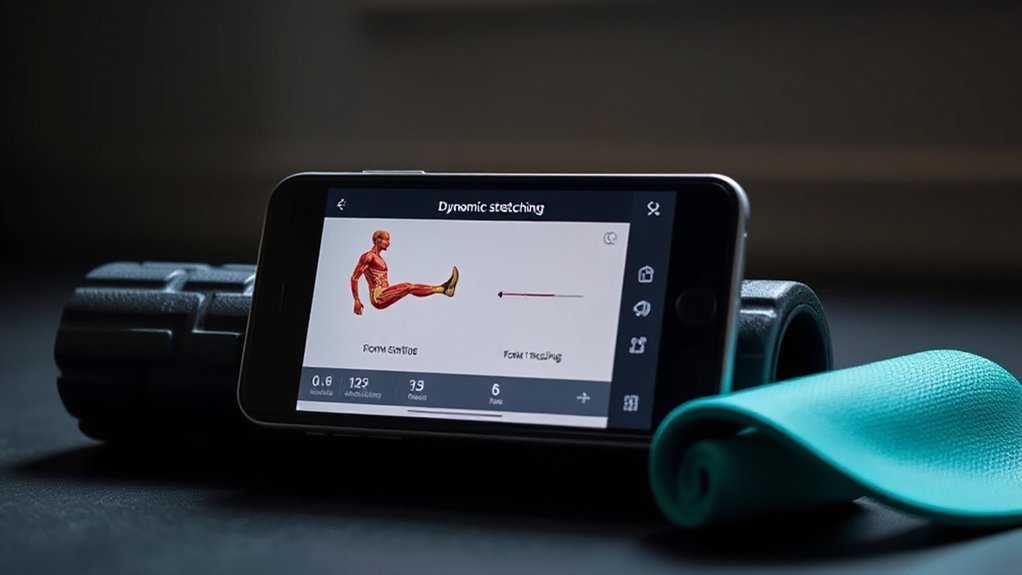
So what actually separates a great stretching app from one that’ll sit unused on your phone?
The real difference comes down to what’s built specifically for runners like you. You’ll want apps that distinguish between dynamic warmups before runs and static cooldowns after—think short, movement-focused sequences paired with longer, held stretches. Look for run-specific programs with mobility assessments, like ROM tests or squat evaluations, so the app adapts to your actual flexibility needs.
| Feature | Why It Matters | What to Check |
|---|---|---|
| Video demos + cues | Prevents injury, guarantees correct form | Clear shifts, side-switch prompts |
| Tracking & reminders | Builds consistency | Weekly streaks, habit tools |
| Offline downloads | Works anywhere, anytime | Customizable length and intensity |
You’ll also want clear video demonstrations with voice or visual cues guiding shifts—no rushed five-second holds here. Finally, prioritize apps offering tracking, habit tools, and integrations like Apple Health. This combo transforms stretching from occasional to automatic, fitting your varied runs and recovery days seamlessly.
Why Runners Need Prerun Warmups and Postrun Cooldowns?
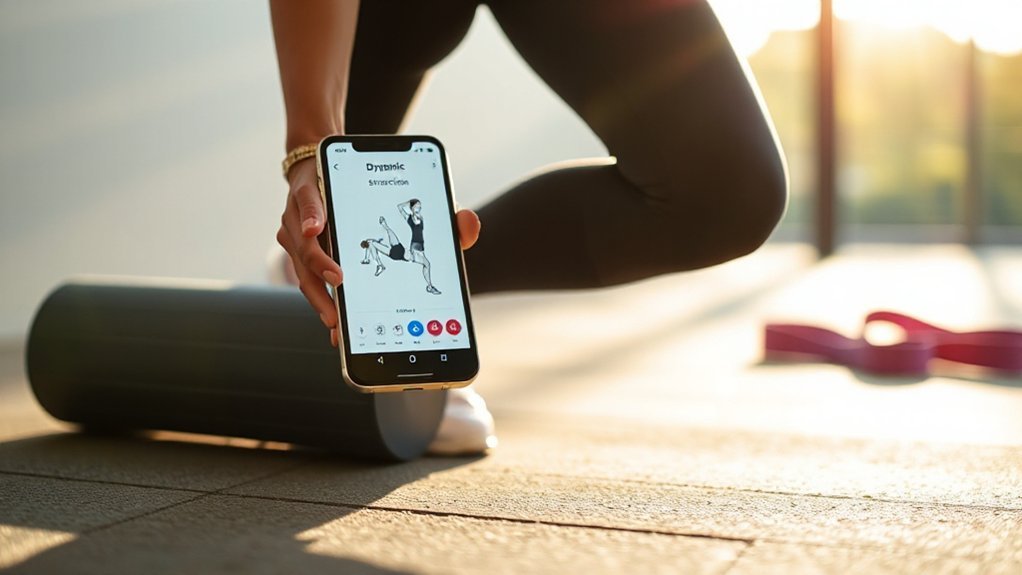
If you’ve ever laced up and bolted out the door without a warmup, you’ve probably felt that stiff, sluggish first mile—your muscles haven’t caught up yet. Here’s why you need both bookends to your run:
That stiff, sluggish first mile hits different when muscles haven’t warmed up yet—here’s why bookends matter.
- Raise muscle temperature – A 3–5 minute dynamic warmup (leg swings, lunges, high-knees) preps your body to move efficiently and cuts injury risk fast.
- Improve flexibility safely – Static stretches belong *after* running, not before. Gentle 5–10 minute holds for hamstrings, calves, hips, and glutes boost mobility without overstretching cold muscle.
- Shift your nervous system – A proper cooldown (light jogging plus stretching) flips your body from stress mode into recovery mode, lowering heart rate and promoting real relaxation.
- Catch problems early – Postrun scanning reveals tight spots—IT band, lower back, calves—before they become chronic issues that sideline you.
Consistency matters. Even short routines compound into better mobility, fewer injuries, and faster recovery between workouts.
Setting Up Your App for Consistent Daily Use
Most people quit stretching apps within two weeks—not because the stretches don’t work, but because they never built it into their day. You’ve got to make this stick, and that starts with ruthless honesty about when you’ll actually stretch.
Pick three fixed times: 9:00 a.m., 1:00 p.m., 9:00 p.m.—whatever slots fit your life. Set reminders on your phone. Non-negotiable.
Start with five to ten minutes daily. Sounds tiny? It’s not. Consistency beats intensity every single time.
Build one custom routine now—neck, lower back, hips—so you’re not deciding what to do when motivation’s low. Save it. Use it.
Enable progress tracking and synch to Apple Health if you want accountability teeth. Streaks matter, though realistic goals matter more.
Use the app’s timers, videos, and gentle cues. Pause when you need pose guidance. Adjust pacing if the app allows.
You’re not chasing perfection. You’re building a habit.
Free vs. Premium: Which Plan Works for Runners?
Nearly every one dangles a free tier in front of you, then quietly locks the good stuff—personalized routines, longer sessions, ROM testing, downloadable videos—behind a paywall. Here’s what you’re actually deciding between:
- Free tier: Basic stretches, limited variety, no run-specific content
- Premium plans ($8–$20/month): Personalized plans, prerun warmups, cooldowns, full video library
- Annual subscriptions: Often cheaper—Down Dog’s $59.99/year or GOWOD’s $107.99/year beat monthly rates
- Travel-friendly features: Downloadable videos and Apple Health sync justify premium costs when you’re offline
Most apps offer 7- to 14-day free trials, so test them first. If you want 3-minute prerun routines and 5-minute cooldowns tailored for runners, you’ll need paid access. The sweet spot? Grab premium if you’re traveling, running offline, or serious about tracking progress. Otherwise, the free tier scratches the basic itch.
Frequently Asked Questions
Is the Stretchit App Free?
StretchIt’s not fully free—you get a 7-day trial to explore, but after that? You’ll need a subscription. They’ve got a basic tier with limited content, though your real access to premium classes and programs requires paying. Expect around $19.99/month, or grab the annual plan at $159.99 for better savings. Watch for promotional discounts; they happen regularly.
Is Stretchit Worth It?
StretchIt’s worth it if you’re serious about flexibility—dancers, athletes, and advanced users swear by it. You’re getting downloadable classes, extensive programs, and real progress tracking. Yeah, $160 yearly stings if you’re casual, but the variety and offline access justify the cost. Beginners might struggle though; routines lean challenging. Bottom line: you’re investing in quality content, not just another stretching app.
So
You’ve got the tools now—pick your app, commit to the routine, and watch your running transform. Whether you’re stretching before dawn or cooling down after miles, consistency’s your real coach. Your body’s a garden; these apps are your seeds. Plant them daily, tend them honestly, and you’ll harvest stronger legs, fewer injuries, and genuine joy in every stride. That’s it. Start today.







Leave a Comment