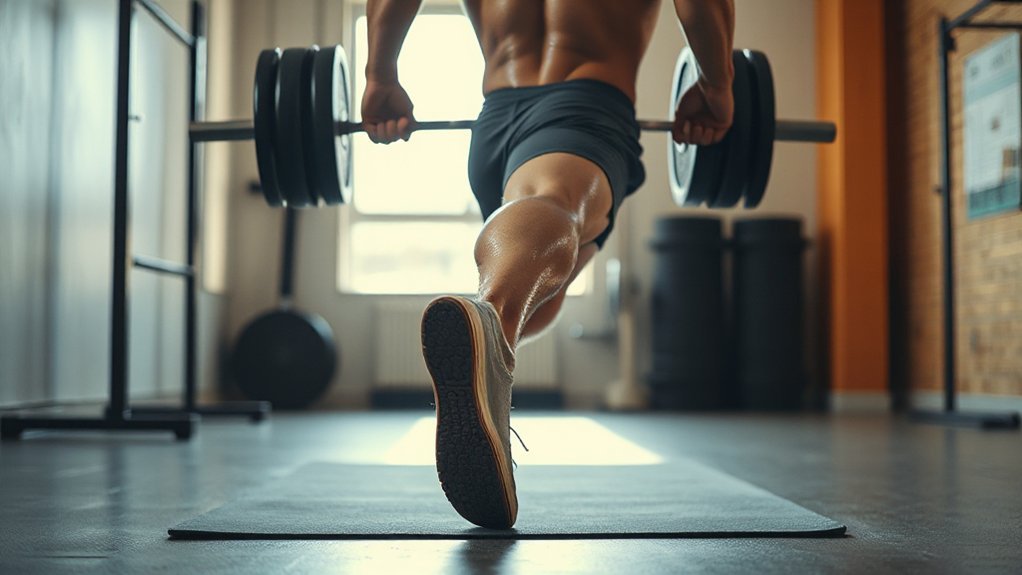

A split squat loads one leg at a time—front foot planted, rear foot elevated on a bench—forcing each leg to work independently and exposing strength gaps you didn’t know you had. You’ll drive through your front heel, sink to roughly 90 degrees, and feel your quads, glutes, and core firing hard to keep you upright and balanced. It’s a unilateral powerhouse that builds serious single-leg strength. Want to nail the form and access variations for your goals?
Key Takeaways
- Split squats are unilateral exercises with one leg forward and rear foot elevated on a bench to expose strength imbalances.
- Front knee should bend to 90° with vertical shin; rear knee descends to ~1 inch above floor without contact.
- Primary muscles worked include quadriceps, glutes, hamstrings, core, and adductors for stability and hip extension power.
- Common errors include knee valgus collapse, excessive forward lean, and rear foot positioning; correct with glute cues and proper bench height.
- Program split squats for strength (8–10 reps heavy), hypertrophy (12–16 reps controlled), or power (explosive movements); train up to 3× weekly per leg.
What Is a Split Squat?
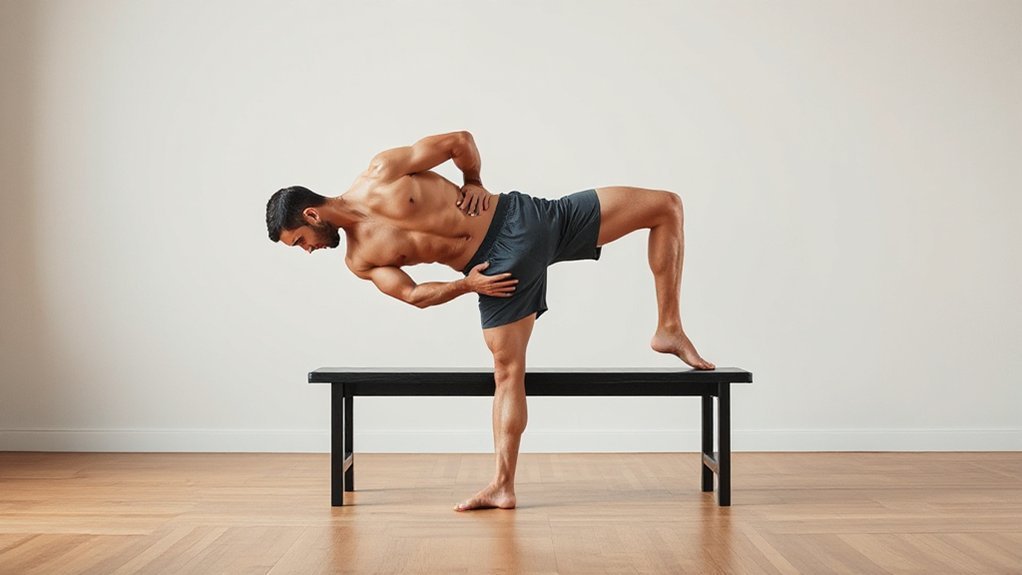
Building serious single-leg strength doesn’t require fancy equipment or complicated programming—just one bench, one leg doing the heavy lifting, and you.
A split squat is a unilateral lower-body exercise that loads one leg at a time. You’ll position your front foot on the floor and elevate your rear foot on a bench or platform behind you. From there, you lower your back knee toward the ground until your front knee bends to about 90 degrees, then press back up.
Here’s what makes it work: your front leg’s quads and glutes do most of the labor, while your core stays engaged to keep your torso upright and balanced. You’re not letting that front knee drift past your toes—control matters. Whether you’re bodyweight or holding dumbbells, kettlebells, or a barbell, split squats expose strength imbalances between your legs fast. They’re basically lunges’ steadier, more focused cousin.
How to Set Up and Perform a Split Squat
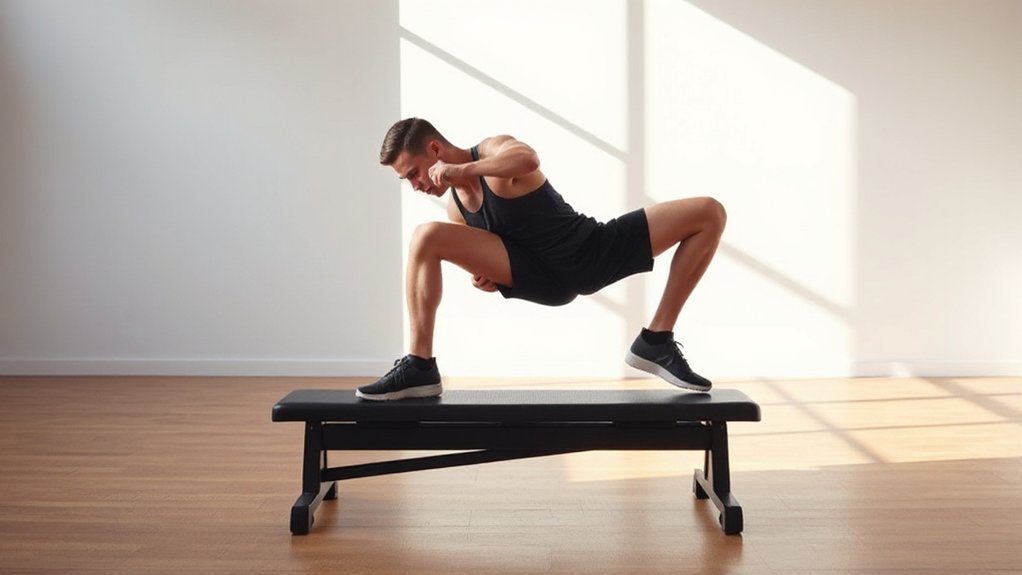
Get your setup right, and everything else falls into place.
Stand with feet hip-width apart, front foot forward, rear foot elevated on a knee-height bench or box. Your front knee should bend to roughly 90° with the shin staying vertical—that’s your target position. Hold a dumbbell at your chest or sides, whichever feels natural. Brace your core, pull your ribcage in, keep your spine neutral, and look straight ahead.
Now descend with control. Lower your rear knee toward the floor while maintaining that vertical front shin. Stop about an inch above ground—don’t let the back knee actually touch down. Then drive through your front foot. Heel emphasis targets your glutes and hamstrings; ball of foot targets quads. Squeeze that front glute hard and return to start before your rear knee contacts the floor.
Start with bodyweight for technique: three sets of 15–20 reps per leg, then progress to weights for three sets of 8–10 reps with 45-second rest between sets.
Which Muscles Do Split Squats Target?
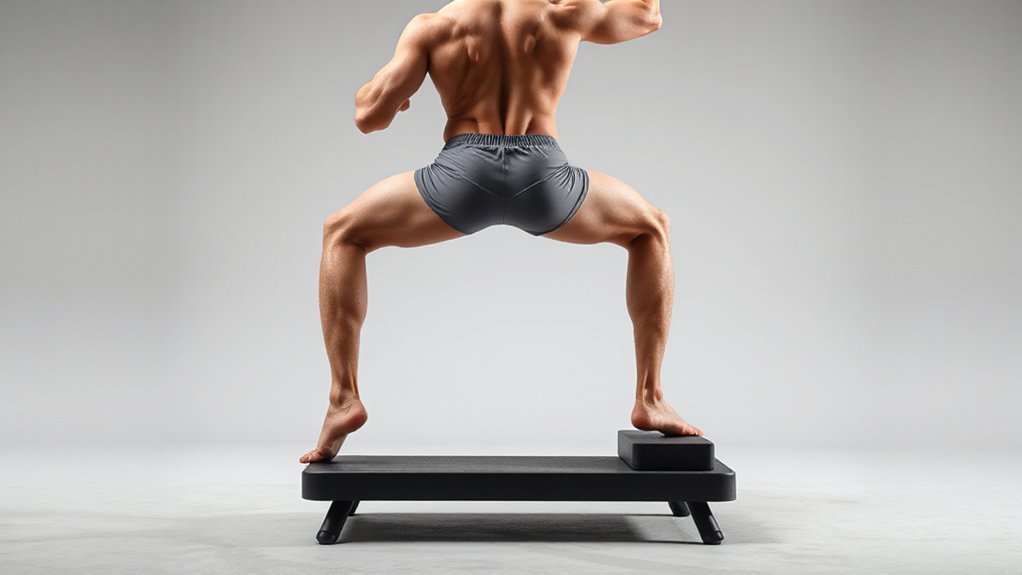
Understanding which muscles fire during a split squat helps you dial in your form and maximize what you’re really after from the exercise.
Your front leg does the heavy lifting here—literally. The quadriceps drive knee extension during the push-up, while your glutes and hamstrings power the ascent, especially when you take a longer stride. Here’s what’s working:
- Quadriceps – primary mover of the front leg
- Glutes and hamstrings – hip extension and drive
- Adductors – frontal stability and thigh control
- Core and erector spinae – trunk stability throughout
Your calves stabilize your ankle and help with push-off, ramping up activation when you drive through the ball of your foot. The medial adductors? They’re quietly managing side-to-side control during descent and ascent. This single-leg movement demands serious stabilization, which means your entire posterior chain and core stay engaged. That’s why split squats build both strength and balance.
Split Squat Form Mistakes and How to Fix Them
Even though split squats look deceptively simple—one leg forward, one back, squat down—the devil’s in the details.
Your front knee probably caves inward (we call that valgus collapse). Fix it: squeeze your glute hard and cue that knee to track over your second toe the whole way down. You’re also likely letting your front knee travel past your toes, losing that essential 90° angle. Step your foot slightly forward so your shin stays vertical at the bottom, stopping when your front thigh hits parallel.
Squeeze your glute and track your knee over your second toe. Keep your shin vertical and front thigh parallel.
Here’s another common trap: rear foot too high or too close to the bench, tilting your hips and wrecking your balance. Use a knee-height bench and adjust distance until you can lower with an upright torso, maintaining a controlled 1-inch gap between back knee and floor.
Finally, don’t round your upper back or lean forward excessively. Brace your core, retract those shoulder blades, chest up, eyes forward. Treat the descent as controlled, pause just above the floor, then drive through your front heel to power up.
Split Squat Variations: Strength, Hypertrophy, and Power
Now that you’ve nailed the fundamentals, it’s time to dial in your split squat for a specific goal—because one rep scheme doesn’t rule them all.
Your training aim shapes everything: load, volume, tempo, stance width. Here’s how to match your variation to what you’re chasing:
- Strength: Heavy dumbbells or barbells, 3–4 sets of 8–10 reps per leg, ~45-second rests. Load takes priority.
- Hypertrophy: 3 sets of 12–16 reps (or 15–20 bodyweight), controlled eccentrics, paused bottoms, extended time-under-tension before adding weight.
- Power: Jumping split squats or explosive concentric drives from your front heel with moderate load—fast intent matters most, plus controlled landings.
- Muscle bias: Narrow stance and ball-of-foot drive emphasizes quads; longer stance and heel-drive emphasizes glutes and hamstrings.
Dead-stop variations let you train heavier safely by resetting at the bottom, no back-knee contact required. Pick your goal, dial your variation, and commit.
Programming: Reps, Sets, and Frequency for Split Squats
How many reps, how many sets, and how often should you actually be doing split squats? Here’s the thing: it depends on your goal, but we’ve got a clear roadmap for you.
Split squats: the rep and set prescription depends on your goal, but we’ve got the roadmap.
Start with three sets of 5–8 reps per leg if you’re new to this—bodyweight only, focus on form first. As you get stronger and more comfortable, push toward 12–16 reps.
For muscle growth, dial in 3–4 sets of 8–12 reps with added weight, resting about 45 seconds between sets. Want raw strength? Keep reps low (3–5) and load up heavy. Need a finisher? Crush 3 sets of 15–20 high-rep reps without weight.
Frequency-wise, you can train split squats up to three times weekly. Place heavy work early when your legs feel fresh, save higher-rep stuff for later in your session. Count each leg as one set—and never let that back knee kiss the floor.
Frequently Asked Questions
Can Split Squats Replace Traditional Barbell Back Squats in a Training Program?
Yeah, split squats can genuinely replace barbell back squats, though they’re not identical. You’ll build serious leg strength and muscle—especially in your quads and glutes—without the spinal load. The trade-off? You’re working one leg at a time, so you won’t shift as much total weight. Stack ’em heavy, nail your form, and you’ve got a solid alternative that’s actually easier on your lower back.
How Do Split Squats Compare to Lunges for Unilateral Lower-Body Development?
Split squats give you more stability, letting you load heavier weight per leg. Lunges? They’re trickier—you’re moving through space, which demands better balance but taxes your core differently. You’ll feel split squats hammer your quads and glutes harder with less coordination overhead. Lunges build functional strength, though. Pick split squats for raw power development; choose lunges when you want dynamic, real-world carry-over.
What Equipment Options Work Best for Split Squats Beyond Dumbbells?
You’ve got solid options beyond dumbbells. Barbell split squats? Game-changer for heavy loading. Kettlebells work great if you like offset weight, really cranks your core. Resistance bands add accommodating tension, perfect for explosiveness. TRX or suspension trainers let you go bodyweight-focused, which honestly, builds stability like nothing else. Even a weighted vest keeps hands free. Pick what matches your goals—strength needs barbells, mobility needs bands.
How Should Split Squats Be Integrated With Bilateral Leg Exercises Weekly?
You’ll want to pair split squats with bilateral moves two to three times weekly. Here’s the rhythm: do split squats on one day—say, Monday—hitting unilateral strength hard. Then Thursday, run bilateral compound lifts like back squats or leg presses. This combo builds single-leg stability while maintaining overall power. You’re strengthening imbalances without neglecting coordinated leg development. Think of it as specialization meets foundation work, keeping you balanced and strong.
Are Split Squats Suitable for Athletes With Knee Pain or Injuries?
Here’s the thing—you’d think a unilateral exercise would *ease* knee stress, right? It actually depends on your specific injury. Split squats can work beautifully for you if you modify depth and load smartly. Keep your front knee tracking over your toes, avoid excessive forward lean, and start shallow. You’re building single-leg stability without jarring impact. But honestly? Check with your PT first. They’ll know your exact situation better than anyone.
So
You’ve built a solid foundation with split squats—they’re your secret weapon for balanced leg strength. Don’t just chase numbers; nail your form, vary your rep ranges, and stay consistent. Like a plant that needs proper soil and sunlight, your legs’ll only flourish when you’re deliberate about programming and recovery. You’ve got this. Now get to work.







Leave a Comment