
You can improve sleep with practical, evidence-based strategies most people haven’t tried. Try peripheral cooling rituals, timed small casein snacks, spectral evening light control, and directional low-level sound to speed sleep onset and deepen rest. These interventions are simple to trial and measurable—here’s how to put them into practice.
Shift Evening Light Exposure to Signal Sleep Readiness
Because your circadian system is highly sensitive to short-wavelength (blue) light, shifting evening light exposure helps your brain recognize it’s time to wind down. You should implement spectral dimming and targeted lumens reduction across devices and room lighting one to two hours before bed; controlled studies show phase-delaying and melatonin suppression decrease with lower blue content and intensity. Use warm-spectrum bulbs, enable night modes on screens, and set dimming schedules that reduce illuminance progressively. Keep task lighting available for activities, but avoid broad-field overhead brightness. Monitor subjective sleepiness and sleep onset latency to gauge response; adjust timing and intensity based on consistent sleep-wake data. These interventions complement sleep hygiene and are supported by randomized and controlled laboratory experiments, and meta-analyses reinforce effectiveness in adults.
Time Small Snacks to Improve Overnight Rest
Alongside shifting evening light, timing small pre-bed snacks can influence sleep continuity and morning glucose control. You should choose modest portions 30–60 minutes before sleep to reduce nocturnal hunger without provoking late glycemic excursions. Prioritize protein timing: 10–20 g of casein or Greek yogurt promotes satiety and stable overnight glucose. Combine with a low-glycemic carbohydrate if needed. Avoid high-sugar treats that trigger insulin peaks and sleep fragmentation. Monitor responses with a glucose meter or sleep diary; adjust portion and timing. These strategies improve sleep continuity and support glycemic control in people with metabolic vulnerability.
| Snack | Rationale |
|---|---|
| Greek yogurt (15g protein) | Sustained amino acids, stable glycemic control |
| Banana + almond butter (small) | Low-glycemic carb + fat for satiety |
Consult clinician if you use insulin regularly.
Tune Your Bedroom Microclimate Beyond Temperature
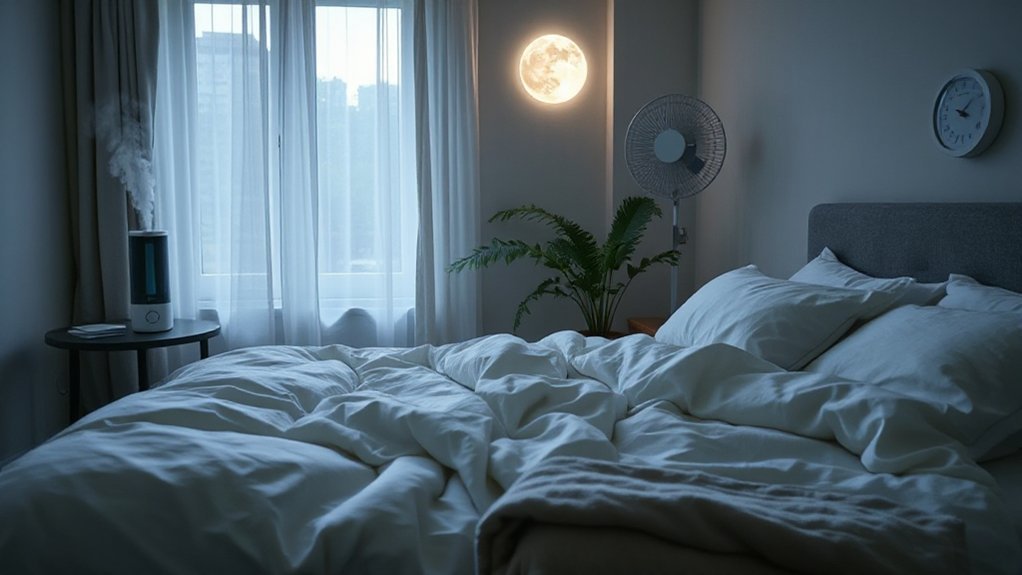
While temperature matters, optimizing your bedroom microclimate also means controlling humidity, ventilation, air quality, and noise to support sleep physiology and respiratory comfort. You should target relative humidity between 40–60% to reduce airway irritation and microbial growth; use dehumidifiers or humidifiers with hygrometers for precise humidity control. Maintain regular ventilation: brief windows opening or mechanical systems exchange indoor air and lower pollutant load. Consider CO2 monitoring overnight; elevated CO2 correlates with sleep fragmentation and daytime sleepiness. Filter particulates with a HEPA unit if you have allergies, and remove VOC sources like scented candles. Reduce noise to below 30–35 dB where possible, or use masking consistent with sleep stage stability. Implement these measures incrementally and track subjective sleep and objective metrics. Adjust based on data.
Rethink Nap Strategy for Better Nighttime Sleep
If you rely on daytime naps, reassess their timing and duration to protect nighttime sleep and consolidate slow-wave and REM cycles. You should set clear Nap Intentions: decide whether the goal is alertness restoration, mood stabilization, or performance recovery. Limit naps to 10 to 20 minutes for a quick alertness boost, or use a single 60 to 90-minute nap only when sleep debt is significant; both approaches minimize slow-wave fragmentation at night. Avoid late-afternoon naps that shorten sleep drive. If naps disrupt nocturnal sleep, implement Nap Alternatives such as brief light exposure, physical activity breaks, or controlled caffeine timing to restore function without reducing homeostatic pressure. Monitor subjective sleepiness and nighttime sleep latency; adjust your strategy based on objective or diary-based outcomes for accuracy.
Use Targeted Pre-Sleep Cooling Techniques
How you manage pre-sleep temperature can meaningfully speed sleep onset and deepen early slow-wave sleep: lowering core or distal skin temperature by about 0.5–1.0°C in the hour before bedtime has consistent, controlled evidence showing faster sleep latency and improved sleep efficiency.
| Feeling | Action | Result |
|---|---|---|
| Calm | Wrist cooling | Faster sleep |
| Relief | Temple cooling | Deeper sleep |
| Control | Timed use | Confidence |
You should try targeted peripheral cooling—wrist cooling or temple cooling—for 20–30 minutes pre-sleep to reduce distal skin temperature and trigger thermoregulatory sleep initiation. Controlled trials support mild cooling devices or cold packs for faster sleep onset and improved efficiency. Apply moderate, tolerable cooling; avoid numbness. Track effects with a sleep diary or wearable, and combine with consistent timing. Don’t replace medical care for chronic insomnia.
Condition Sleep With Specific Scents and Aromas
Because your olfactory system links scent with memory and emotion, you can condition sleep by pairing a specific, pleasant aroma with your wind-down routine to create a reliable bedtime cue. Choose a single, mild scent—lavender, cedar, or a subtle citrus—and use it consistently each night during relaxation activities like reading or progressive muscle relaxation. Over 1–3 weeks olfactory conditioning can associate that aroma with sleep onset, reducing sleep latency in some studies. Apply scent via a diffuser, pillow spray, or scent strip positioned near your head, keeping concentrations low to avoid stimulation. Monitor responses: if the aroma causes alertness or irritation, stop. Combine scent anchoring with standard sleep hygiene; they’re an adjunct, not a standalone treatment for chronic insomnia. Discuss use with your clinician safely now.
Train Your Circadian Rhythm With Timed Activity
When you schedule physical activity at consistent times each day, you harness a powerful non-photic zeitgeber that helps entrain your circadian clock. You should time exercise to strengthen sleep-wake timing and metabolic cues.
- Morning light exposure plus moderate activity to advance circadian phase and boost daytime alertness.
- Midday or afternoon sessions to consolidate wakefulness and avoid late-evening stimulation.
- Fixed social scheduling with peers and a strict caffeine curfew to enhance adherence and prevent masking of circadian signals.
Shift timing gradually by 15–30 minutes every few days. Monitor sleep latency and daytime function, and consult professionals for shift work or persistent circadian disorders. Individualize timing based on response and comorbidities, using objective measures when possible. Review progress with clinicians regularly for safety.
Add Brief Mindful Movement Before Bed
If you add 10–20 minutes of gentle, mindful movement—such as restorative yoga, slow tai chi, or a guided body‑scan with stretching—20–60 minutes before bed, you’ll lower sympathetic arousal and prime parasympathetic activation to shorten sleep latency and improve subjective sleep quality. You should choose low-intensity sequences emphasizing gentle stretching and slow shifts to avoid cardiovascular stimulation. Focus on breath awareness to downregulate cortical hyperarousal; inhale and exhale slowly with a 4–6 second rhythm and coordinate movement to exhalation. Evidence from randomized trials and mechanistic studies shows brief, low-intensity movement reduces nocturnal awakenings and improves perceived sleep continuity. Keep sessions consistent nightly, limit room lighting, and stop stimulating activities afterward. Contraindications are minimal; if you have specific medical conditions, consult your clinician for tailored guidance.
Choose Bedding and Pillow Materials That Aid Sleep
Choose bedding and pillows based on fiber type, support, and thermoregulation, since these factors measurably affect sleep continuity and comfort. Natural fibers like cotton and wool and synthetic options each have trade-offs in breathability, allergen burden, and moisture-wicking that you’ll match to your symptoms. Pick pillow loft and firmness that maintain neutral cervical alignment, and use temperature-regulating materials (phase-change, moisture-wicking, breathable fills) if nocturnal overheating disrupts your sleep.
Natural Vs Synthetic Fibers
Although natural fibers generally offer superior breathability and thermal regulation, engineered synthetics often outperform them in moisture-wicking, durability, and ease of care. You should weigh allergen load, microplastic shedding and dye toxicity against performance metrics; choose materials that limit chemical exposure and particle release. Prioritize sleep by matching fiber properties to your thermoregulation and hygiene needs. Use evidence-based labels: certified organic cotton, TENCEL™, and performance polyester differ in lifecycle impacts and care instructions. Balance comfort with maintenance: some synthetics dry faster and resist microbes, while some naturals absorb moisture better. Practical selection reduces nocturnal awakenings and skin irritation. Consider laundering protocols and certifications to minimize exposure and maximize longevity.
- Choose breathable weave
- Verify certifications
- Follow care instructions
Improve restorative sleep nightly.
Pillow Loft and Support
Because proper cervical alignment reduces neck pain and sleep fragmentation, match pillow loft and support to your sleep position and body dimensions to keep your cervical spine neutral. You should select pillow fill and shape based on measured neck length, shoulder width, and mattress firmness; evidence shows tailored loft customization improves spinal alignment and reduces microarousals. For side sleepers pick higher, firmer pillows; back sleepers need medium loft with neck support; stomach sleepers require thin, soft options. Consider adjustable inserts or shredded-fill for incremental changes. Assess comfort during a 2-week trial and track morning pain. If persistent discomfort occurs, consult a clinician trained in sleep medicine or musculoskeletal care for function.
| Position | Recommended loft | Support |
|---|---|---|
| Side | High | Firm |
| Back | Medium | Contoured |
| Stomach | Low | Soft |
Temperature-Regulating Materials
When selecting bedding and pillows, prioritize materials that move heat and moisture away from your skin so your core temperature can follow the normal nocturnal decline. Evidence supports using fabrics that enhance evaporative cooling and conductivity. 1. Linen – high breathability and moisture wicking; low Manufacturing footprint and durability. 2. Tencel (Lyocell) – engineered cellulose fiber with superior moisture management and biodegradable profile. 3. Phase-change or PCM-infused fibers – actively absorb and release heat; validate claims with lab thermal testing and sleep-study outcomes. Also weigh allergen resistance and laundering effects on performance. Consider Smart integration only when interoperability improves thermoregulation. Rely on standardized metrics (thermal resistance, wicking rate) and peer-reviewed data to select bedding that objectively supports nocturnal core-temperature decline. Replace regularly to maintain.
Integrate Spatialized Sound Cues Instead of Constant Noise
You should prefer spatialized, directional sound over constant broadband noise to reduce habituation and preserve sleep architecture. Evidence shows adaptive spatial cues that shift location or intensity in response to movement improve sleep continuity and lower arousal compared with steady-state masking. Implement headphones or multi‑speaker setups with algorithmic positioning to target cues away from the head and minimize overall sound level while maintaining efficacy.
Directional Sleep Sounds
How might spatialized sound cues improve sleep compared with constant masking noise? You’ll get targeted stimulation that reduces startle responses and preserves sleep architecture; studies show directional cues can minimize arousal while lowering overall SPL, supporting hearing safety and requiring attention to delivery latency to avoid phase errors. Use directional speakers or binaural tracks to localize sounds without constant masking.
- Position sources to steer attention away from sleeper and limit intensity.
- Use low-frequency, transient cues timed to stage shifts to ease consolidation.
- Monitor SPL and latency; adjust to maintain thresholds that protect cochlear function.
You’ll adopt clinically tested, minimally invasive methods that favor restorative sleep. Implement with clinician oversight, measure outcomes with polysomnography or validated wearables, and document improvements objectively in the clinical record.
Adaptive Spatial Cues
Building on the benefits of directional cues, adaptive spatial cues adjust localization, timing, and level in real time to replace constant masking noise with targeted, phase-consistent stimulation that minimizes arousal and preserves sleep architecture. You’ll benefit when spatialization systems map salient sounds to consistent focal landmarks around your bed, creating predictable auditory anchors that reduce microarousals. Algorithms monitor EEG or movement proxies and shift pathway markers to reinforce desired sleep stages, lowering sensory gating without continuous broadband energy. Clinical trials show reduced wake after sleep onset and preserved slow-wave activity versus steady noise. Implementing calibrated, low-level spatial cues requires individualized mapping, controlled exposure, and validated hardware and protocols. Use evidence-based devices and clinician guidance to integrate adaptive spatial cues safely into your sleep regimen.
Leave a Comment