

Start your morning with tiny, intentional actions that stack into momentum: prep clothes and essentials the night before, drink water when you wake, do a five-minute micro-task, then set one top priority for the hour. Keep devices off while you open blinds and move for 20 minutes. Follow these simple hacks and you’ll change how your day unfolds—here’s how to make it stick.
Start With a Micro-Task

Starting with a micro-task kickstarts momentum and makes getting going effortless. You pick one small, specific action—make your bed, write a single sentence, sort three emails—and you win immediately. Those tiny wins lift your confidence and chain together into longer focus. Set a 5-minute timer, commit, and use that slot for skill rehearsal: practice one piano scale, one coding problem step, or one breathing cycle. You’ll see progress without overwhelm, which builds a habit loop: cue, action, reward. Repeat daily, slightly raise the bar when it feels easy, and celebrate each completion. Micro-tasks reduce resistance and prime you for bigger work while keeping mornings lean, intentional, and momentum-rich. Don’t skip planning; note the next small step so momentum carries into your first major task.
Limit Decision Fatigue
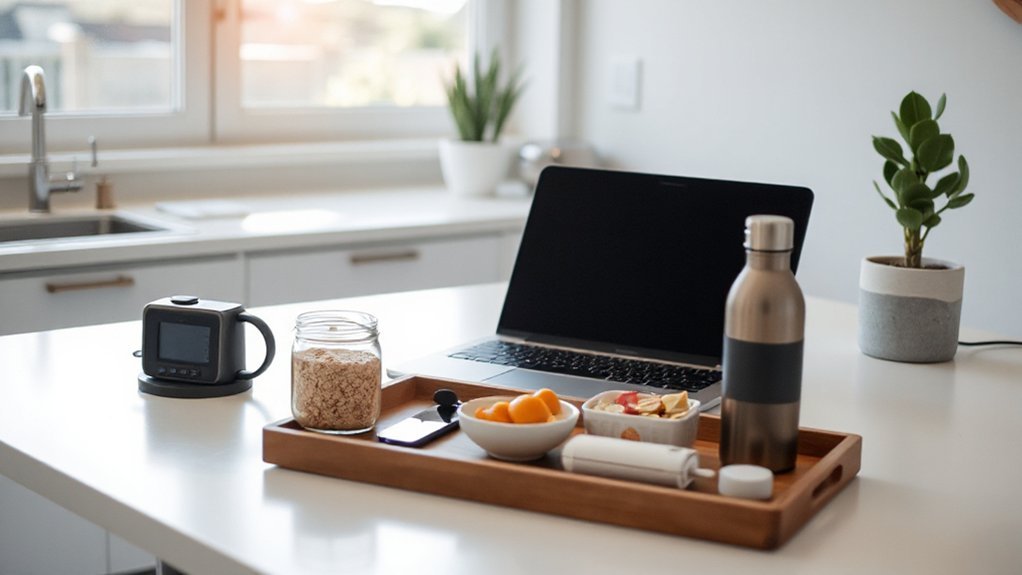
Decide fewer things up front to save willpower for what matters: pick three nonnegotiables—what you’ll wear, what you’ll eat, and your top morning task—and set them as defaults the night before. You’ll lower friction by creating Default Rules: limit choices to two options per category and stick to them until they feel automatic. Adopt a Uniform Wardrobe for workdays or a capsule set to remove style decisions. Choose a reliable breakfast and one focused priority that advances your goals. When choices are fewer, you’ll move faster, feel calmer, and preserve energy for creative work. Review your rules weekly and tweak only when needed. Commit to simplicity; repetition builds momentum and makes productive mornings effortless. Start small today and protect decisions for higher-impact tasks daily.
Prep the Night Before

If you prep the night before, you’ll wake up with momentum instead of a to-do list—lay out your clothes, pack your bag, set out breakfast ingredients, and queue your top morning task so you can move immediately. Create an outfit layout: pick shoes, accessories, and layers so dressing’s automatic. Pack essentials into your bag—laptop, charger, wallet, keys—and place them by the door. Prep breakfast items and a travel mug to grab and go. Make a short commute checklist: transit card, headphones, address, or parking info. Set simple alarms tied to these items. Review tomorrow’s top priorities for two minutes, then sleep. Nightly prep removes friction, builds confidence, and converts mornings into momentum. Do this five nights a week and notice your mornings shift dramatically.
Use a 20-Minute Movement Routine
Spend 20 minutes each morning on a movement routine that wakes your body and sharpens your focus. Start with a 10-minute full-body mobility flow—slow joint circles, hip openers, and thoracic twists—to loosen tight spots and improve range of motion. Then hit a 10-minute high-intensity mini-circuit—bursts of squats, push-ups, and kettlebell swings with short rests—to raise your heart rate and energy for the day.
Full-Body Mobility Flow
How about a 20-minute routine that wakes every joint, loosens tight areas, and primes your body for movement? Start with spinal articulation and scapular stability drills: slow cat-cows, thoracic rotations, scapular slides. Move through hip circles, ankle pumps, and squats to open hips and ankles. Include dynamic lunges and arm circles to build range and coordination. Flow, 45–60 seconds per exercise, rest 15 seconds, repeat circuit twice. Focus on control, breathing, and full range, not speed. Use the table below.
| Exercise | Focus |
|---|---|
| Cat-Cow / Thoracic Rotation | Spinal articulation |
| Scapular Slides / Arm Circles | Scapular stability |
| Hip Circles / Ankle Pumps | Hips & ankles |
Start now—consistency beats intensity. Do this daily and notice improved posture, energy, and movement clarity fast.
High-Intensity Mini-Circuit
While you’ve only got twenty minutes, you can torch calories and build strength with a high-intensity mini-circuit: pick five compound moves, do 30–45 seconds on and 15–20 seconds off, and cycle the set 3–4 times for a metabolic blast—focus on clean reps, controlled breathing, and full effort. You’ll alternate moves like squats, push-ups, kettlebell swings, lunges and rows to hit major muscles and boost focus. Start with warm-up, keep switches tight, scale intensity to suit you. For Apartment Adaptations, swap jumps for step-ups or low-impact burpees; pad floors, use mats. Prioritize Noise Minimization with controlled landings and resistance bands. Finish with a two-minute breath reset to lower heart rate and lock productivity surge—you’ll leave energized, fully confident.
Hydrate Immediately
Drink a glass of water first thing to jump-start your energy, sharpen your focus, and help digestion. Keep a bottle by your bed or mix in a pinch of salt and lemon for fast electrolyte replenishment. Aim for 16–20 ounces (about 500–600 ml) within the first hour and sip more steadily after that.
Benefits of Early Hydration
A glass of water first thing jumpstarts your system and sets a productive tone for the day: you’ll rehydrate after sleep, sharpen your focus, boost metabolism, aid digestion, and curb unnecessary snacking. You’ll notice a Metabolic boost and better Mood stability that help you tackle tasks with clarity. Make it a simple, non-negotiable cue: sip before your phone, before caffeine, before decisions. Benefits include faster wakefulness, reduced appetite, clearer thinking, and steadier energy. Act on them.
- Faster wakefulness and improved focus
- Appetite control to prevent mid-morning grazing
- Steadier energy and mental clarity
- Supports digestion and overall recovery
Make it a habit and you’ll start each morning energized, focused, and less distracted — small effort, big productivity payoff every single day.
Quick Hydration Methods
Kickstart your morning by reaching for water the moment you sit up — keep a glass or bottle by your bed so you don’t skip it. Make hydration automatic: prep a full bottle the night before, stash an insulated one in the fridge, or set an alarm to sip before reaching for your phone. Use infuser bottles with fruit or herbs to make water inviting without sugar, and try electrolyte mixes when you need a quick refresh after sweat or poor sleep. Keep a small cup on your dresser, use a straw or sports-cap for effortless sipping, and place a visible reminder where you’ll look first. These simple habits make hydrating immediate, effortless, and motivational so you start focused and energized every single day.
How Much to Drink
After you’ve made morning sips automatic, aim to drink about 300–500 ml (10–17 oz) within the first 30 minutes to rehydrate and kick your system into gear. That amount jump-starts circulation, aids Kidney function, and reduces morning grogginess. Adjust volume by body weight: larger people need toward the higher end. Sip steady rather than chugging.
- Weigh yourself occasionally to gauge hydration needs.
- Start with 300 ml and add 50–100 ml per 10 kg above 60 kg.
- If you have health issues, check with a clinician to protect Kidney function.
- Follow with small drinks through the morning to maintain focus.
Make this a nonnegotiable habit; your energy and clarity will improve. Commit daily and you’ll notice better concentration, mood, and sustainable productivity in three weeks.
Batch Tiny Tasks
Batching tiny tasks—like emails, quick replies, and small chores—lets you clear errands fast so you can focus on deeper work.
Pick a 15 to 30 minute slot, list 6 to 12 tiny tasks, and attack them in one sprint. Group similar items: email replies, household tweaks, and micro-organization like labeling jars or button sorting. Use a timer, shut distractions, and move items to done. Repeat mid-morning if needed. Stay strict: anything longer than 10 minutes gets deferred.
| Task | Goal |
|---|---|
| Email replies | Clear inbox |
| Quick fixes | Fix small problems |
| Organize spots | Labeling jars |
| Tidy items | Button sorting |
Celebrate small wins; they’ll compound and fuel your momentum into bigger tasks throughout the day. You’ll finish quickly and preserve willpower for meaningful work. Stay consistent daily always.
Set an Intention or Top Three Priorities
Once you’ve cleared those quick wins, pause and choose your top three priorities for the day. Pick tasks that move you forward and reflect Values Alignment — work that fits your goals and energy. Say a short Morning Mantra that reminds you why each priority matters. Then list the actions you’ll take, keeping scope small and decisive:
- Identify the single outcome for each priority.
- Choose the first actionable step you can finish within 30–90 minutes.
- Note one obstacle and a quick mitigation.
- Commit to starting now.
Time-Block Your Morning Window
Choose a clear start and end for your morning window so you know when your focus begins and when it ends. Put your highest-impact tasks first so you’ll get the biggest wins while your energy is highest. Schedule short buffers between items to absorb overruns and reset quickly.
Define Start and End
When will your morning begin and end—set exact times and treat that window like a nonnegotiable appointment. Claim that span, then guard it with shift cues and time anchors so your day starts intentionally. Decide a start and an end, then commit.
- Choose precise clock times (e.g., 6:15–7:30) and block them.
- Use a short ritual as a shift cue to signal focus.
- Set an end alarm as a time anchor to stop and shift.
- Review the next day’s window each evening to reinforce habit.
You’ll reduce decision fatigue, build consistency, and protect morning momentum. Consistency beats perfection—stick to the window for two weeks, tweak, and lock it in. Small, repeated boundaries create unstoppable mornings and steady productivity gains daily.
Prioritize High-Impact Tasks
Now that you’ve claimed a morning window, block it for your highest-return work first. Use Impact Mapping to list tasks that move goals forward; connect each task to a measurable outcome. Do a quick Value Estimation—score tasks by expected impact and effort—to rank what deserves that prime time. Put the top one or two tasks into single-focused, uninterrupted blocks and set a clear goal for each block. Start with the hardest impact item while your energy’s highest, then tackle the next in descending value. Protect this time: silence notifications, close unrelated tabs, and communicate boundaries. At day’s start you’ll build momentum, deliver more meaningful progress, and shorten the path from intention to outcome. Make this habit daily; you’ll see sustained gains in weeks ahead.
Schedule Short Buffer Times
Since your best work comes in focused sprints, block short buffers (5–15 minutes) between morning time blocks to handle switches, quick admin, and unexpected interruptions. You’ll preserve momentum and reduce friction when tasks flow into one another. Use Shift Buffers as deliberate pauses: breathe, review next actions, close tabs, or jot a note. Treat these buffers as Calendar Slack — non-negotiable mini-breaks that protect deep work.
- End each session with a one-sentence next-action.
- Schedule 5–15 minute gaps after intensive tasks.
- Use alarms to enforce buffer start and end.
- Convert overruns into prioritized micro-tasks.
Commit to this rhythm for a week and you’ll notice fewer context-switch costs and calmer mornings. Track results and adjust buffer length to fit your workflow daily.
Use Cue-Based Habit Triggers
If you want your morning habits to stick, tie each one to a clear, consistent cue—time, place, or a preceding action you already do. Choose a cue that’s impossible to miss: put your workout clothes by the bed, set your mug by the kettle, or start journaling right after brushing. Use visual reminders and social prompts—leave a sticky note, set a quick message in a group chat, or tell a partner you’ll do it. Start small: link a two-minute habit to an established routine, then expand once it’s automatic. Track successes for a week to build momentum. When cues reliably trigger action, your morning flow becomes effortless and you’ll actually look forward to the productive start. Commit to cues, and watch your consistency grow.
Create a Tech-Minimal First Hour
You’ve anchored habits to reliable cues—now protect that momentum by creating a tech-minimal first hour. Wake, hydrate, and step toward sunlight to prioritize Sunlight Exposure and reset your circadian rhythm. Swap scrolling for Analog Rituals: journaling, stretching, and reviewing a single daily intention. Set phone to Do Not Disturb and keep it in another room.
- Open blinds and breathe for five minutes.
- Drink water, stretch, jot one gratitude.
- Plan one top priority; avoid app checks.
- Reward completion with a brief phone check.
This routine reduces decision fatigue, boosts focus, and builds momentum. Stick to it for two weeks; adjust timing, not tools. Consistency compounds: small mornings yield outsized productivity gains when you protect your focus and energy daily every morning.






Leave a Comment