

Master the RDL and you’ll bulletproof your posterior chain—but here’s the thing: you’ve got to treat it like a hip hinge, not a squat. Plant your feet hip-width apart, brace hard, then push your hips straight back while keeping that bar glued to your legs. Feel the hamstring stretch, drive through your big toe on the way up, and squeeze explosively. Get those fundamentals locked down first, because nailing the foundation opens doors to supramaximal loading and potentiation work that’ll transform your strength.
Key Takeaways
- Feet hip-width apart with weight on mid-foot; soften knees 8–10° and brace core before each rep.
- Push hips back in a hip hinge while keeping the bar glued to your legs throughout descent.
- Lower until hamstrings lengthen between knee-top and mid-shin; avoid excessive depth or allowing knees to collapse inward.
- Drive your big toe into the floor and explosively squeeze glutes to initiate the ascent and lockout.
- Pack lats and sweep the bar against thighs to prevent bar drift and reduce potentially harmful lumbar shear.
Build Your RDL Foundation: Foot Position, Breathing, and Knee Unlock

Nailing your foundation means getting your feet right—and honestly, this is where most people stumble before they even start moving. Position your feet hip-width apart with weight distributed mid-foot, emphasizing your big toe slightly. This setup keeps you balanced and lets you press that big toe down during the lift, firing up your glutes from the start.
Now, here’s the key: keep your knees softened at about 8–10°—not a squat, just a gentle bend. This small angle shifts load into your hamstrings while keeping your shins vertical. Before each rep, inhale deep into your belly and brace hard. Engage your lats, protect your spine, maintain that neutral torso. Think of it as preparing your body to hinge, not fold. This breathing and bracing work together, creating the stable foundation that makes everything else possible.
Execute the RDL: Descent, Depth, and Reversal
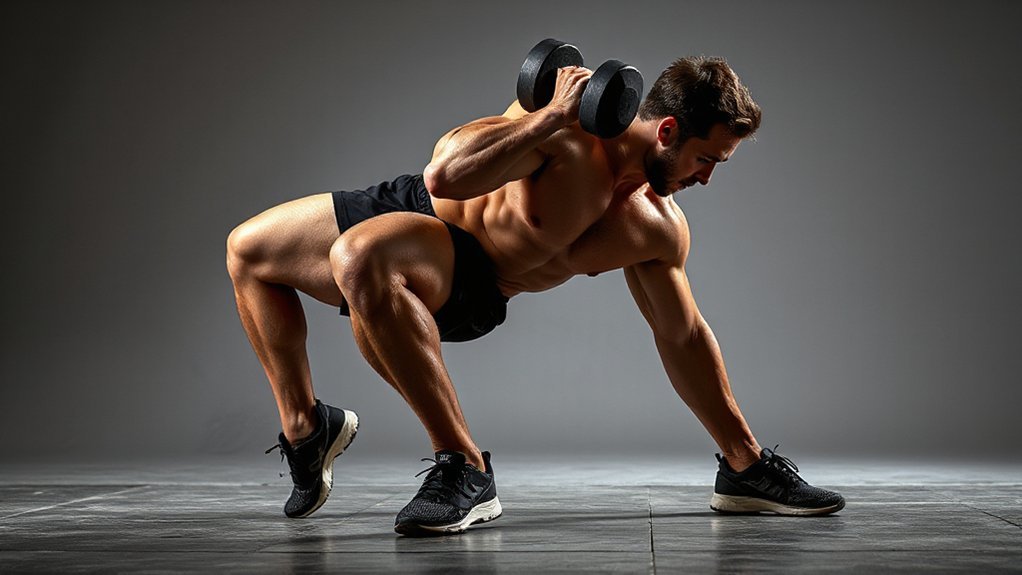
Once you’ve locked down that solid foundation—feet set, breath braced, knees soft—you’re ready to actually move. Release your knees just 8–10°, then push those hips straight back like you’re reaching for something behind you. Keep the bar glued to your legs; it shouldn’t drift. Feel your hamstrings lengthen as you descend—that’s your depth cue, not some arbitrary floor target. You’re aiming somewhere between knee-top and mid-shin, deeper only if your mobility allows it without your torso collapsing forward.
Stay engaged. Lats locked, core braced, bar hugging you the whole way down. On the way up? Drive your big toe hard into the floor while explosively squeezing those glutes to stand those hips up. That’s the reversal. For heavy sets, use straps and reset your breath at the top between reps. You’ll maintain better technique, grip stays strong, and you’ll actually finish tough.
RDL Form Faults and Fixes
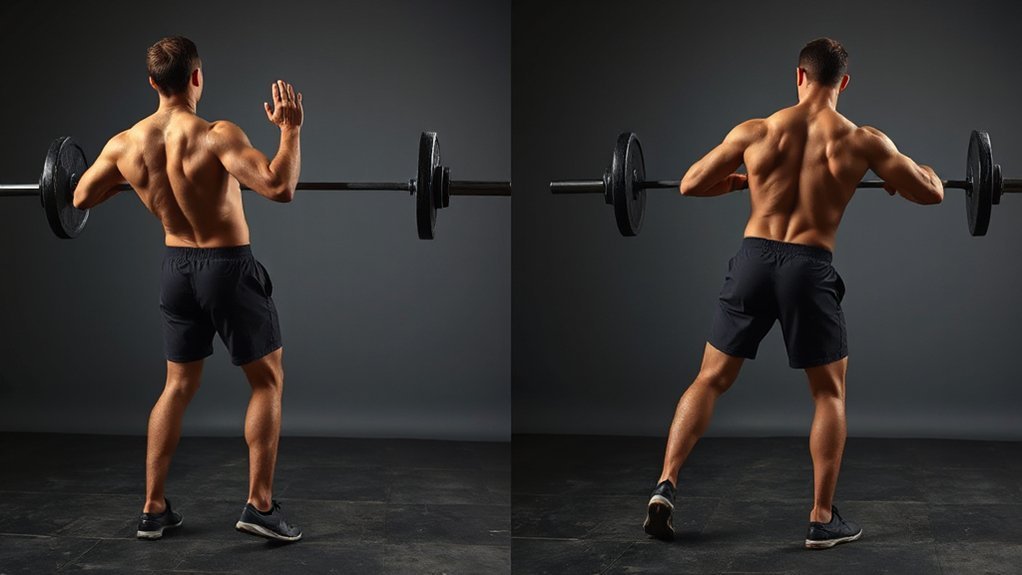
Even with your foundation locked and your descent dialed in, little breaks in form can snowball into big problems—and you’ll feel them before you see them. Your body whispers first, then shouts.
Here’s what typically derails you:
- Knees give out or the bar drops too low — Your hinge mechanics are compromised. Push your hips back harder, limit descent to where you feel a hamstring stretch (mid-shin territory), and stay honest about your range.
- Bar drifts away from your legs — This kills your lower back. Pack your lats, sweep that bar against your thighs, and reinforce upper-back tension so lumbar shear stays off the table.
- Thoracic spine rounds at depth — Build upper-back strength, practice horizontal pulls, and use a shallower hinge until your spine plays along.
Small fixes now prevent big injuries later. Stay vigilant.
Advanced: Supramaximal RDL Loading (For Experienced Lifters)
When you’ve spent a couple years building a rock-solid RDL foundation—nailing form, hitting consistent volume, feeling genuinely strong in the movement—there’s a legitimate next step: supramaximal eccentric loading.
Here’s the deal: you’re using ~80% of your 1RM, sometimes 25% heavier, but you’re ditching the concentric entirely. Two spotters return the bar while you control the descent for 7–10 seconds. No grinding up. Pure eccentric tension.
Why? Your muscles adapt to overload faster under lengthening tension. You’ll feel stronger, build serious resilience, and pack on posterior chain mass.
But—and this matters—expect brutal soreness and systemic fatigue. Limit these sessions per block, recover hard, and skip max-velocity sprinting; your hamstrings’ll stay jacked up otherwise.
Start with submaximal tempos first, master your technique completely, and bring competent spotters. This isn’t vanity lifting—it’s earned progression.
RDL Potentiation Pairs and Clusters
You’ve crushed the eccentric overload work, your form’s locked in, and you’re genuinely strong—now it’s time to weaponize that strength into speed and power.
Potentiation pairs exploit acute neural priming by pairing heavy RDL sets (80%+ of max) with mechanically similar, high-velocity exercises. Your nervous system’s already fired up from the heavy lift, so you channel that readiness into explosive work.
Potentiation pairs harness acute neural priming—pair heavy lifts with explosive work while your nervous system’s primed and ready to fire.
Here’s what you’re stacking:
- A1 Heavy RDL (4×3 at near-max) primes your posterior chain with serious eccentric tension
- A2 Banded KB swing or med-ball throw (4×5) captures that potentiation window while velocity stays crisp
- Advanced move: Layer in a French Contrast Cluster—alternating RDL, banded swing, overspeed pull, and horizontal med-ball jump for dense neuromuscular stimulus
Timing matters deeply though. Plant these potentiation blocks off-season or away from sprint phases, because heavy eccentric work and increased tonus can actually blunt your high-speed running. Keep your recovery solid, stay intentional, and watch your power translate.
Frequently Asked Questions
Are RDLS Good for Hamstrings?
Yeah, RDLs are legitimately fantastic for your hamstrings. You’re loading them under serious stretch tension—especially that biceps femoris—which triggers real hypertrophy. The key? You’ve gotta lift heavy, around 80% of your max or higher. Light stuff won’t cut it. That hip hinge, the eccentric lowering, the range of motion—it all combines to build serious hamstring strength and muscle. They’re worth your time.
What Does RDL Work the Most?
You’re hitting your hamstrings hardest with the Romanian deadlift—especially that biceps femoris. But here’s the thing: your glutes aren’t just along for the ride. They’re actually driving the show on the way up, powering hip extension big-time. Your back muscles? They’re working isometrically, keeping your spine stable throughout. So yeah, hamstrings take center stage, but you’re really building your whole posterior chain.
So
You’ve got the tools now—foot position locked, breathing controlled, form dialed in. Take Sarah, a runner who added RDLs to her routine; her hamstrings strengthened, her knees stopped aching, her sprints improved dramatically. That’s what happens when you stop rushing and actually master the movement. You’re not just lifting weight; you’re building resilience, preventing injury, and unleashing real performance. Start light, progress smart, own it.







Leave a Comment