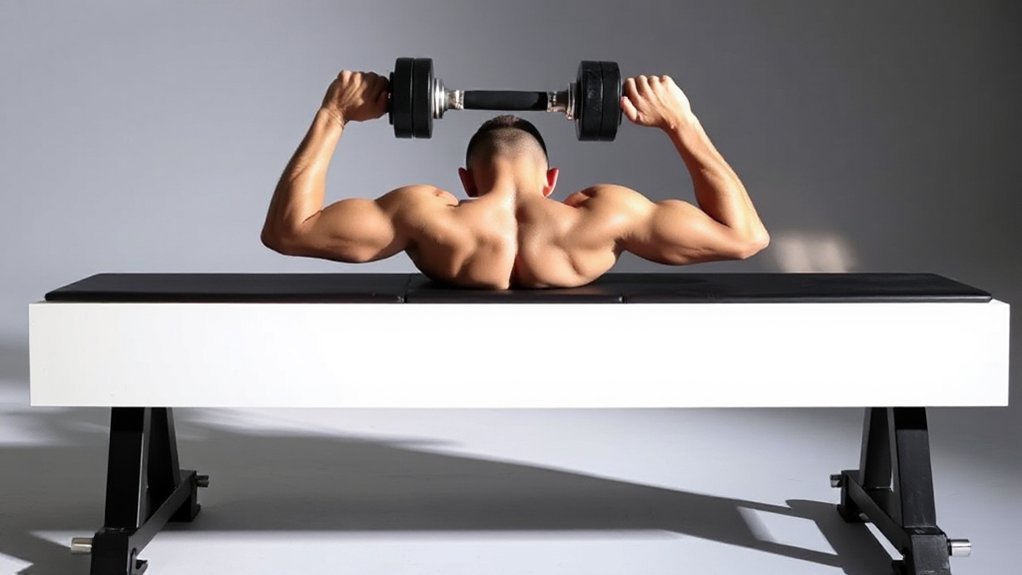

The dumbbell pullover’s your secret weapon for hitting chest and back at once—but here’s the catch: arm position changes everything. Keep your elbows tight and hug the weight to your torso, you’re crushing lats. Arc it over your chest with straighter arms? Pecs take over. Start light (10–25 pounds), control the descent for 2–4 seconds, brace your core hard, and avoid overarching your lower back. Slot it as a finisher on chest days or early on back days. The real magic happens when you nail which angle serves your actual goals.
Key Takeaways
- Single-dumbbell pullover targets chest and lats simultaneously; arm position and elbow angle determine primary muscle emphasis.
- Proper form requires controlled descent with slight elbow bend, core bracing, and movement only within shoulder mobility limits.
- Start with light weight (10–25 lb) and perform 3–4 warm-up sets of 8–12 reps to build movement competency safely.
- Program as a chest finisher (8–15 reps) or back pre-fatigue exercise (6–12 reps) depending on training day focus.
- Common errors include loading too heavy, overarching the lower back, excessive elbow flare, and rushing repetitions without control.
What Muscles Does the Dumbbell Pullover Really Target?

Here’s the deal: when you keep your arms tight and the weight hugs your torso, your lats take the lead. But arc that dumbbell over your chest? Your pectorals wake up and often steal the show—EMG studies prove it. Your long head triceps chips in throughout the lift, especially with bent arms. Your anterior delts stabilize the overhead path, keeping everything smooth.
And don’t sleep on your serratus anterior. That muscle fires hard when you squeeze at the top, creating that protraction “plus” position that locks your shoulder blade down. Your core? Working overtime to prevent your spine from folding backward. That’s the real magic here—layered, whole-body engagement wrapped in one beautiful arc.
How to Perform the Dumbbell Pullover: Form and Safety
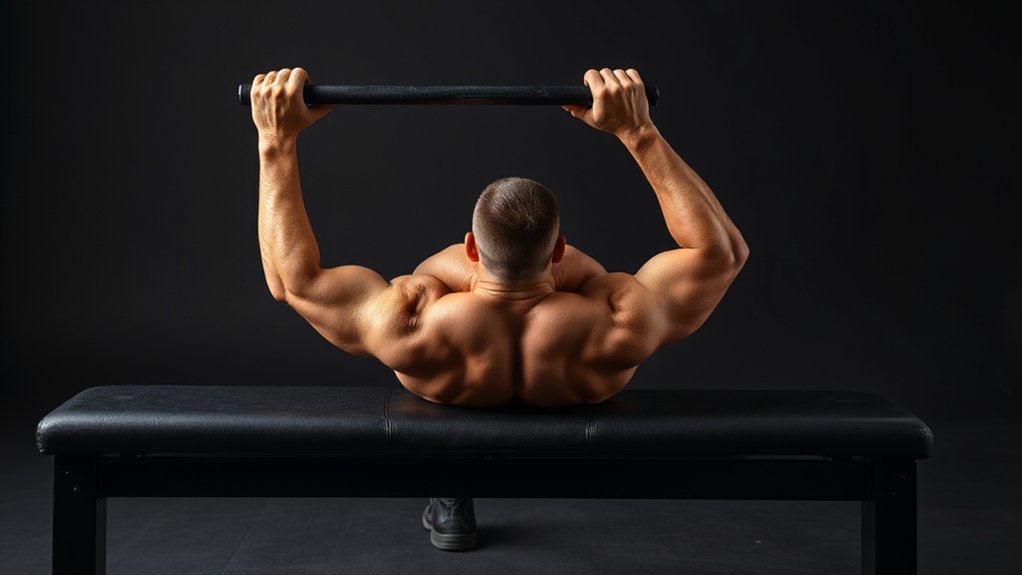
When you nail the setup, everything else falls into place—so let’s build your foundation first. Position yourself on a flat bench with your upper back and shoulders supported, hips slightly lower than your chest, feet planted firmly on the ground. Hold a single dumbbell vertically over your sternum with a slight, fixed bend in your elbows. Here’s what happens next:
- Inhale and lower the dumbbell in a controlled arc behind your head only as far as your shoulder mobility allows—stop before lumbar extension or pain kicks in
- Exhale and pull it back over your chest using your chest and lats, not momentum or swinging
- Brace your core and keep ribs down throughout to protect your lower back and maintain tension
Start light—10–25 pounds—and warm up with 3–4 sets of 8–12 reps to nail the pattern before adding weight. Prioritize control over load. Avoid locking elbows, using hip drive, or pushing through sharp shoulder pain. You’ve got this.
Chest or Back? Adjusting Arm Position for Your Goals

Want to turn the pullover into a chest-builder or a back-annihilator? Your arm position is everything.
Keep those arms straighter with just a slight elbow bend, and drive the dumbbell closer to your forehead and chest. Squeeze your pecs hard as you bring the weight back over your sternum—that’s chest mode. You’re controlling the path, keeping it tight, focused.
Keep arms straighter, drive the dumbbell toward your forehead and chest, squeeze hard—that’s chest mode, controlled and focused.
Now flip it. Flare your elbows wider, let the dumbbell travel in a broader arc behind your head, and stay closer to your torso. That longer range of motion? It loads your lats differently, giving you that deep stretch you’re after. Wider angles plus full range equals serious lat recruitment.
Here’s the real move: a wider elbow angle on a bench—not the floor—cranks up shoulder extension torque. Less range of motion shifts stress back to your chest. And if you really want to light up your serratus? Finish each rep pushing straight up with scapular protraction. Same movement, totally different results.
Where the Pullover Fits in Your Training Program
Pullovers aren’t picky, but they’re strategic. You can slot them into chest days as a finisher—3 to 4 sets of 8 to 15 reps to hammer that pec stretch and squeeze. Or you can run them early on back days for lat pre-fatigue, bumping volume to 4 sets of 6 to 12 reps. The real magic? Using them on upper-body days where you’re already mixing push and pull work.
Here’s what wins:
- Pair with horizontal pulls one session, vertical pulls another—keeps overlap minimal and your joints happy
- Treat them as efficient double-duty exercises—you’re hitting chest *and* back qualities in one movement
- Slot them strategically around your main lifts—don’t bury pullovers after you’re already gassed
Basically, build your pullover timing around what else you’re training that day. Smart placement means better recovery and stronger gains.
Dumbbell Pullover Mistakes That Kill Your Results
How’d you go from solid pullover form to wondering why your shoulders feel wrecked and your chest isn’t growing?
You’re probably loading too heavy. Starting with a bench-press weight kills the whole point—your shoulders compensate, momentum takes over, and your lats and pecs check out. Begin around 10–25 pounds instead.
You’re also likely overarching your lower back to squeeze out extra range. That’s a trap. The moment your hips lift or your lumbar spine takes strain, you’ve crossed the line. Stop the descent or use partial range.
Then there’s elbow flare. Keep them bent at a modest, consistent angle—excessively splayed elbows turn this into a sketchy shoulder rotation that dilutes pec and lat engagement.
Finally, you’re probably rushing. Slow your descent to 2–4 seconds, brace your ribs down, and drive back with muscle, not swing. Control wins growth.
Frequently Asked Questions
What Are 5 Pull Exercises?
You’ve got five stellar pull exercises to build a serious back. First, pull-ups—your vertical gold standard, hitting lats and biceps hard. Then bent-over barbell rows for thick middle back. Single-arm dumbbell rows fix imbalances while sparing your spine. Lat pulldowns let you progress smartly as a beginner. Finally, face pulls? They’re your shoulder-health secret weapon, reinforcing those rear delts and external rotators you can’t ignore.
Is a Pullover Necessary?
No—you don’t need pullovers. Think of ’em like dessert: nice, but not required for nutrition. That said, they’re *genuinely useful* if you’re short on time. One movement hits chest and lats simultaneously, plus they mobilize your shoulders in ways rows and presses won’t. Start light, screen your shoulder health, and use ’em strategically—maybe 3–4 sets finishing chest day. They’re optional tools, not essentials.
So
You’ve literally got a thousand-pound chest and back builder right here. Master your arm angle, nail that form, and you’ll unleash gains you didn’t know existed. The dumbbell pullover? It’s your secret weapon. Toss it into your routine strategically, avoid those common mistakes, and watch yourself transform. You’re closer to your goals than you think—just execute it right.





Leave a Comment