

The Pallof press trains your core to resist rotation—not create it—by anchoring a band or cable at chest height and pressing straight out while your trunk stays locked in place. You’re building deep stabilizers and oblique strength that transfer directly to heavier squats, deadlifts, and safer spinal protection. Start with 3–4 sets of 10–15 reps per side, twice weekly, and progress from kneeling to standing as your form sharpens. Master this movement first, and you’ll understand why serious lifters swear by it.
Key Takeaways
- Anti-rotation core exercise that builds trunk stiffness and resists external rotational forces through deep stabilizers and obliques.
- Anchors band or cable at chest height; stand perpendicular, press straight out while resisting torque with neutral spine.
- Strengthens transverse abdominis, multifidus, obliques, and stabilizers to transfer force through compound lifts and athletic movements safely.
- Progress from kneeling to standing to split-stance variations; increase tension distance and add tempo work for advancement.
- Program 2–4 times weekly as warm-up or finisher; avoid torso rotation, locked elbows, and excessive low-back arch.
What the Pallof Press Is and Why It Matters
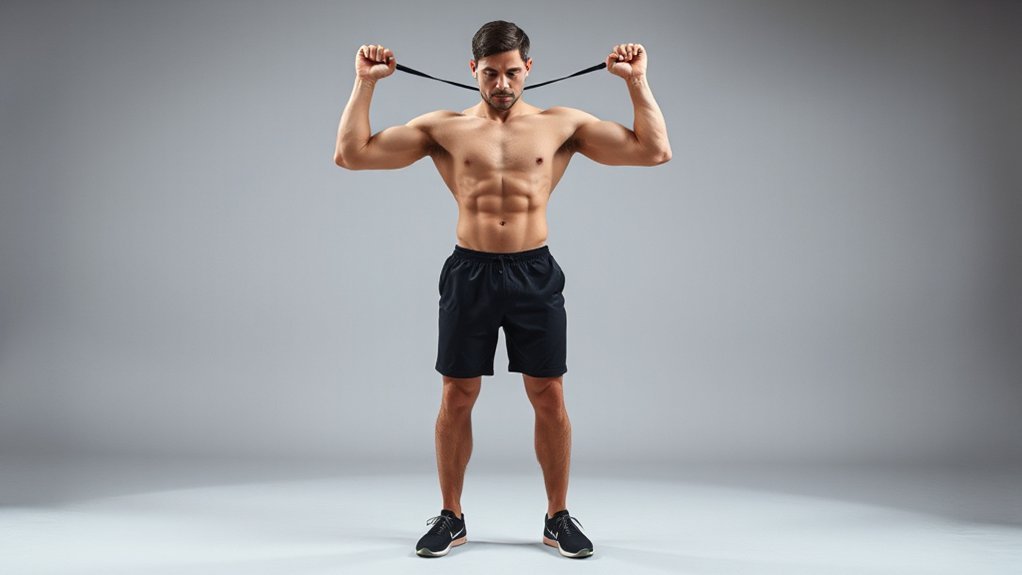
The Pallof press isn’t your typical ab exercise—it’s an anti-rotation core move that’ll teach your trunk to stay stiff while something’s actively trying to twist you apart. You’re standing perpendicular to a cable or band anchor, pressing straight out from your chest. Sounds simple? The trick is resisting that rotational pull without rotating. Your deep stabilizers—think transverse abdominis, multifidus—fire up hard to keep you locked down. Your obliques engage too, but they’re working *against* rotation, not creating it. That’s the magic here. Instead of crunching forward or twisting side to side, you’re training anti-movement. Why does that matter? Because a rigid, stable trunk transfers power better through compound lifts and athletic actions like golf swings and tennis backhands. Plus, it’s low-impact, rehab-friendly, and measurable—perfect for building genuine, functional strength.
Master Your Pallof Press Form: Setup and Execution

How do you actually set this thing up? Let’s break it down so you nail it from the start.
Break down the setup so you nail it from the start—stability, tension, bracing, and form matter most.
- Anchor your band or cable at chest height, then stand perpendicular with feet hip-width apart and a slight knee bend—you’re creating stability, not rigidity.
- Step away until you feel firm tension holding the handle at your sternum; this distance matters because it determines how hard your core works.
- Before you press, take a deep diaphragmatic breath, brace your core like you’re bracing for a punch, squeeze your glutes, and keep your ribs down with a neutral spine.
- Press straight out until your arms are nearly extended, pause about one second while resisting the pull, then slowly return the handle to your chest.
Perform all reps on one side before switching. Start light—perfect form beats heavy resistance every time.
Which Muscles Work (and Why That Helps Your Lifts)

Now that you’ve got your form locked in, it’s time to understand what’s actually firing under the hood—because knowing which muscles you’re training changes how you approach everything from squats to throwing a medicine ball.
Your core isn’t just one muscle. It’s a team working together, and the Pallof press recruits them strategically. Here’s the breakdown:
| Muscle Group | Role |
|---|---|
| Deep stabilizers (transverse abdominis, multifidus) | Create passive stiffness, limit unwanted rotation |
| Obliques (external and internal) | Generate anti-rotational torque, resist force |
| Rectus abdominis | Brace anterior core, maintain neutral spine |
Your lats and shoulder stabilizers anchor everything, creating a platform for pressing power. Meanwhile, your glutes and hip muscles build that solid foundation beneath you.
Why? Because anti-rotation strength directly transfers to heavier squats, deadlifts, and Olympic lifts. You’re not just building core endurance—you’re engineering stability that protects your spine and amplifies force from your lower body upward.
Progress Your Pallof Press: From Beginner to Advanced
Once you’ve nailed the basics—zero rotation, solid breathing, locked-in posture—you’re ready to actually *progress*. Here’s how to build real strength without trashing your form:
Once you master zero rotation, solid breathing, and locked-in posture, you’re ready to progress and build real strength.
- Move from kneeling to standing – Graduate to split-stance once you nail 2–3 sets of 15 reps with zero torso twist, stepping farther from the anchor point each week.
- Layer in tempo and holds – Add 2–3 second press pauses or 3-second eccentric control; this teaches your core to stabilize under sustained tension.
- Introduce dynamic movement – Pallof walks, lateral lunges, or resisted twists challenge your anti-rotation while your body’s actually moving—way more functional.
- Increase load strategically – Thicker bands, heavier cable loads, but only after you’ve crushed flawless reps at your current level.
Regress immediately if you spot rotation, hip drop, or compensation. Technique trumps weight, always.
Add Pallof Press to Your Training Program
You’ve built solid Pallof strength—now it’s time to slot it into your actual training where it’ll pay dividends for your lifts and bulletproof your core against real-world rotation. The trick? Treat it like a purposeful tool, not an afterthought: use 2–4 sessions weekly as a warm-up to activate stability before heavy compound work, or finish with 3–4 sets of 10–15 reps per side to cement anti-rotation endurance when you’re fresh enough to nail flawless form. Stack it smartly—pair your Pallof presses with lateral lunges or step-outs to challenge integrated stability across your whole body, and you’ll transfer that rock-solid core control straight into your squats, deadlifts, and carries.
Core Stability And Rotation
Building anti-rotation strength—that’s where the Pallof press comes in, and it’s honestly one of the smartest moves you can add to your routine. Your core isn’t just about six-pack abs; it’s your body’s foundation for everything. Here’s what you’re actually building:
- Isometric stability through your transverse abdominis and multifidus, those deep stabilizers that protect your spine
- Global muscle engagement across your obliques, rectus abdominis, and erector spinae working together
- Anti-rotational stiffness that resists that lateral pull, keeping your torso square and locked
- Real-world carryover to heavy lifts, golf swings, and explosive sports movements
When you resist rotation instead of chasing it, you’re training your body to stay solid under pressure. That’s functional strength you’ll actually feel.
Programming Pallof Into Workouts
Since you’ve got the movement down and understand what it’s building, it’s time to stop treating the Pallof press like an occasional accessory and actually weave it into your training plan—because where and how you place it matters just as much as the movement itself. Use it early as movement prep before heavy lifts, priming that anti-rotation stability your spine needs. Or slot it at the end as a finisher to build core endurance without taxing your nervous system. Aim for 2–4 sessions weekly: 3–4 sets of 10–15 reps per side when you’re chasing volume, or 2–3 heavier sets during strength phases. Progress smartly—more tension, greater distance from the anchor, tougher stances—but only when your torso stays rigid and locked. That’s your real win.
Common Pallof Press Form Mistakes and How to Fix Them
Even when you understand the Pallof press’s core benefits, your body’ll try to cheat—it’s just how we’re wired. Here’s what trips up most people:
- Torso rotation toward the anchor — Your core isn’t braced enough. Draw your belly in, squeeze your glutes hard, and use a mirror to keep your chest square the entire rep.
- Locked elbows or shrugged shoulders — Keep elbows soft with a slight bend, retract your shoulder blades, and press downward through them to channel force into your core.
- Arching your low back — Tuck your pelvis slightly and brace aggressively so your spine stays neutral under load.
- Too much tension too soon — Dial back the resistance. Master flawless reps first, then increase incrementally.
Start lighter. Progress slower. Your future self’ll thank you for building this foundation right.
Frequently Asked Questions
Can I Perform the Pallof Press With Dumbbells Instead of Cables or Bands?
Yeah, you can use dumbbells—totally doable. Hold one dumbbell at chest height, feet shoulder-width apart, perpendicular to your target side. Brace your core hard, then press straight out. You’ll feel that anti-rotation work, which is honestly the whole point. It’s less stable than cables, though, so you might not load as heavy. Start lighter, nail your form first, then progress. Simple, effective, no fancy equipment needed.
How Often Should I Include Pallof Press in My Weekly Training Routine?
Like Odysseus steering through treacherous waters, you’re charting your core’s stability—smart move. Include Pallof presses two to three times weekly, spacing them out. Your anti-rotation muscles need recovery, honestly. Pair them with other core work, but don’t overdo it. Start conservatively: one to two sets of ten reps per session. Listen to your body. You’ll notice improved posture and stability within weeks, guaranteed.
What’s the Ideal Rep and Set Range for Optimal Core Strength Development?
You’ll want to hit 3–4 sets of 8–12 reps per side for solid core strength gains. Start with moderate weight—you’re building stability, not ego lifting. Hold each rep for a second, resisting that rotation urge. Your core’s begging for tension and control here. If you’re crushing it easily? Add weight or pause longer. Three times weekly works beautifully with your routine. Quality beats quantity every single time.
Should I Breathe Differently During the Press Versus the Hold Phase?
You’ll want to breathe differently, yeah. During the press phase, exhale as you push the cable away—this stabilizes your core and engages your deep muscles. During the hold, breathe steadily, controlled, resisting the rotation’s pull. Never hold your breath completely; that’ll spike your blood pressure and reduce stability. Think exhale-on-effort, then rhythmic breathing through the static hold. This breathing pattern maximizes your core’s anti-rotation strength.
Can Beginners Start With the Pallof Press or Should They Build Prerequisite Strength First?
You can absolutely start with the Pallof press as a beginner—it’s actually forgiving that way. But here’s the thing: you’ll want baseline core stability first. Try dead bugs or bird dogs for two weeks, get comfortable bracing your abs. Then grab a light band, nail the form with minimal resistance. You’re building anti-rotation strength, not impressing anyone. Start light, progress smart.
So
You’ve built a foundation—now you’ll watch your core stabilize like a tree rooting deeper into soil. The Pallof press isn’t flashy, but it’s honest work that pays dividends across every lift you do. You’re training your body to stay steady when life tries to twist you sideways. Stick with it, progress thoughtfully, and you’ll feel the difference in your strength, your posture, your confidence.






Leave a Comment