

You can boost morning energy by changing how you wake, because research shows fragmented awakenings and snoozing undermine alertness and mood. Adopt consistent wake times, gentle dawn-style light, and a single planned alarm placed away from the bed. Small, evidence-based tweaks deliver measurable gains—start with one simple change to your alarm and see what follows.
Why Snoozing Backfires

Although grabbing the snooze button may seem harmless, it fragments your sleep and deepens morning grogginess. When you return to sleep for short intervals, you repeatedly interrupt slow-wave and REM cycles, increasing Sleep Inertia on final awakening. Experimental studies show fragmented arousals impair reaction time, decision-making, and mood for minutes to hours. You experience Cognitive Fog: reduced alertness, slower processing, and poorer working memory. These effects are physiological, tied to incomplete dissipation of sleep-related neural downstates and adenosine accumulation. To minimize residual impairment, avoid fragmented awakenings and use a single, planned alarm that requires standing or movement to dismiss. That strategy aligns with circadian and homeostatic recovery principles and reduces the physiological drivers of post-awakening impairment. You’ll feel clearer and perform better soon again.
Set a Consistent Wake Time

Keeping a consistent wake time—even on weekends—stabilizes your circadian rhythm and improves daytime alertness and mood. You’ll strengthen sleep–wake homeostasis, making it easier to fall asleep and wake naturally. Aim to keep weekday and weekend wake times within about 30–60 minutes to maintain biological alignment and reduce social jet lag.
Benefits of Steady Schedule
When you wake at a consistent time each day, you stabilize your circadian rhythm and improve daytime alertness and sleep consolidation; trials and cohort studies show fixed wake times reduce night-to-night variability in sleep duration, increase sleep efficiency, and lower subjective daytime sleepiness. You’ll gain measurable benefits: regular timing associates with improved mood stability and reduced depressive symptoms in multiple observational studies. Consistency supports metabolic regulation, with randomized and observational data linking stable sleep-wake schedules to improved glucose tolerance and lipid profiles. Implement a fixed wake time within 30 minutes, maintain morning light exposure, and keep timing consistent. Track outcomes for two to four weeks using sleep logs or actigraphy to assess sleep efficiency, daytime alertness, and mood, then adjust timing to optimize overall.
Sync With Your Biology
To align your circadian system, pick and keep a fixed wake time that you can maintain within about 30 minutes every day, including weekends. This consistency stabilizes sleep pressure and reinforces sleep–wake timing, so your internal clock predicts morning alertness. Use chronotype awareness to choose a wake time that fits your biological preference; night owls should shift gradually toward earlier times if required by work, while morning types can consolidate earlier rises. Regular wake timing entrains hormone rhythms—cortisol peaks and melatonin offsets—improving metabolic and cognitive function. Track sleep and daytime performance for two to four weeks, then fine-tune by 15-minute increments. If you have persistent insomnia or daytime impairment, consult a clinician for personalized chronotherapy or pharmacologic options to optimize long-term morning energy consistently.
Align Weekdays and Weekends
Although weekend schedules often drift, you should keep your wake time within about 30 minutes every day. Consistent wake times stabilize circadian rhythms, improve sleep quality, and reduce daytime sleepiness. When you set alarms, coordinate family agreements and limit variability from social commitments. Use targeted strategies to maintain alignment.
- Set one weekday/weekend target wake time and share with household.
- Adjust evening activities to protect sleep opportunity before wake time.
- Treat social commitments as exceptions, not routine shifts.
- Use alarms and light exposure to reinforce the chosen schedule.
Small, sustained changes produce measurable benefits in mood and cognition. Monitor sleep duration and timing for two weeks, then refine the plan based on objective data and functional outcomes. You’ll track symptoms and adjust accordingly each week.
Use Gentle Alarm Sounds
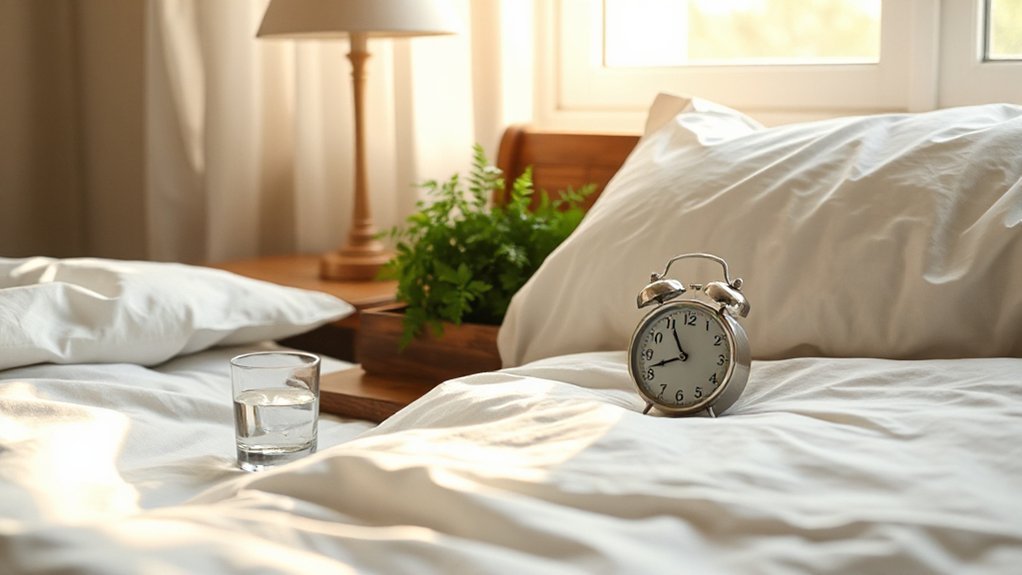
Using gentle alarm tones reduces abrupt sympathetic activation and lowers subjective sleep inertia compared with loud, sudden alarms. You should select alarms with clear melodic choices or subtle nature sounds to promote smoother arousal and preserve morning cognition. Clinical findings support lower cortisol spikes and faster orientation with gradual tonal complexity rather than harsh frequencies. Test tones at your usual wake time and note alertness, mood, and reaction time. Pair consistent timing with these tones to reinforce conditioning. Avoid alarms that mimic emergency signals.
| Feature | Recommendation |
|---|---|
| Tone type | Melodic or nature sounds |
| Frequency | Smooth mid-range tones |
| Purpose | Minimize startle, aid orientation |
| Measure | Track subjective alertness scores |
You’ll adjust choices based on personal response and objective measures weekly systematically.
Gradual Volume Increase
You should set alarms to start soft and increase in volume over a short window to reduce abrupt stress responses. Clinical studies show gradual ramps and incremental wake-up tones improve awakening and blunt morning cortisol spikes compared with sudden loud alarms. Implement a 30–90 second volume ramp with small stepwise increases to balance arousal and comfort.
Start Soft, Grow Louder
When you program an alarm to start quietly and ramp up over 60–180 seconds, research shows it blunts the acute sympathetic surge and improves subjective alertness compared with sudden loud alarms. You should set a gradual-volume profile to reduce startle, preserve sleep inertia recovery, and support consistent wakefulness. Use tones tied to emotional cues and subtle acoustic branding to make the stimulus recognizable without provoking stress. Monitor subjective alertness and morning heart rate to evaluate effectiveness. Practical steps:
- Begin volume at low (10–20% of max) and increase linearly over 60–180s.
- Choose timbres with low-frequency content to avoid sharp transients.
- Pair with predictable timing to reinforce conditioning.
- Adjust per individual sensitivity and comorbid insomnia.
Reassess settings weekly and document outcomes regularly.
Incremental Wake-up Tones
Although abrupt alarms provoke a startle response, incremental wake-up tones that ramp volume gradually reduce the sympathetic surge and reliably improve subjective alertness. You should program alarms to increase volume over 30–90 seconds, aligning with sleep inertia decay. Studies indicate slower ramps lower cortisol spikes and enhance cognitive performance on first tasks. Use predictable frequency patterns that shift from low to midrange to avoid jarring harmonics. Pair volume ramps with gentle music shifts—fade in melody or tempo rather than introducing abrupt new elements—to facilitate cortical activation without alarm-induced anxiety. Keep peak volume sufficient for awakening but not startling, and trial settings across several mornings to calibrate. Measure outcomes subjectively and via simple performance tests to confirm improved morning energy. Adjust based on personal response.
Place Your Alarm Across the Room
Placing your alarm across the room forces you to get out of bed to silence it, reducing snooze use and increasing initial alertness. You’ll interrupt sleep inertia by performing upright posture and simple motor tasks; studies show movement and task engagement raise cortisol and cognitive readiness. Use furniture rearrangement to position the device where you must stand, and plan cord management to keep pathways safe and accessible. Place the device within earshot but out of reach.
- Stand immediately to turn off the alarm.
- Take three deliberate breaths and walk to a bright window.
- Start a single, brief task (make water or open curtains).
- Avoid returning to bed; sit upright for two minutes.
This routine is practical, low-cost, and reproducible. Monitor outcomes and adjust accordingly.
Use Light-Based Alarms
You can use light-based alarms that simulate a gradual sunrise to support circadian alignment and smoother wake shifts. Set the light to increase over 20–30 minutes, beginning with warm, low-intensity hues and shifting toward cooler, brighter tones to promote alertness. Adjust peak brightness and color temperature to your individual sensitivity and room ambient light for ideal effect.
Simulate Sunrise Gradually
When you wake to a light that brightens over 20–30 minutes, your brain gets gradual photic input that suppresses melatonin and phase-shifts circadian rhythms, making arousal easier and more consistent than sudden noise alarms. You’ll leverage physiological entrainment; the method mirrors Sunrise symbolism and echoes Cultural rituals that align activity with light. Use a validated dawn-simulating device and set a progressive onset for your habitual wake time. Monitor sleep, mood, and daytime alertness to assess efficacy.
- Start 20–30 minutes before target wake time.
- Pair with consistent sleep-wake schedule.
- Use light-delivery aimed at eyes while reclined.
- Record outcomes for 1–2 weeks.
This approach reduces abrupt stress responses and improves morning alertness in controlled studies. Expect modest benefits within days and measurable changes by two weeks.
Adjust Brightness and Color
Although dawn simulators provide useful timing cues, tailoring both intensity and spectral content of wake light will better suppress melatonin and boost morning alertness. You’ll set higher short-wavelength (blue) proportion for final 15–30 minutes, then reduce to warmer tones as you wake. Use devices with verified lux and spectrum; verify screen calibration and room ambiance to avoid counterproductive contrast. Keep peak 250–500 lux at eye level for most adults; adjust for age and ocular health. Combine gradual intensity ramp with color temperature shift from ~3000K to 6500K. Monitor subjective alertness daily and sleep inertia; iterate settings weekly. Table summarizes key parameters and clinical rationale.
| Parameter | Target | Rationale |
|---|---|---|
| Intensity | 250–500 lux | Suppresses melatonin |
| Spectrum | 3000–6500 K | Adjusts alerting response |
| Timing | 15–30 min ramp | Reduces inertia |
Align Alarms With Sleep Cycles
By timing alarms to coincide with the end of a sleep cycle, you’ll tend to wake from lighter sleep and experience less grogginess. Use evidence-based cycle lengths (90 minutes) to schedule alarms relative to your bedtime and desired wake time. Choose alarm tools that respect data privacy and verify device compatibility with wearables or apps. Consider:
- Calculate cycles: count 90-minute blocks after sleep onset.
- Use smart alarms that detect movement or REM lightening.
- Prioritize consistent wake windows to stabilize circadian phase.
- Validate algorithm performance against subjective alertness scores.
Track outcomes for two weeks, using objective measures (actigraphy) when possible. Adjust timing iteratively; small shifts (15 minutes) can reduce sleep inertia and improve morning energy. Document perceived alertness each morning on a simple scale.
Limit Evening Screen Time
Because evening screen exposure suppresses melatonin and increases cognitive arousal, you should limit device use in the hour or two before bedtime. Implement a consistent screen curfew and move devices out of the bedroom to enforce a bedroom ban; both reduce light and interactive stimulation that delay sleep onset. Replace scrolling with low-stimulation activities—reading printed material, light stretching, or relaxation breathing—rather than cognitively engaging apps. Silence notifications and use device settings like night shift or blue-light filters only as adjuncts; behavioral restriction is primary. Track adherence for several weeks and note objective changes in sleep latency and perceived morning alertness. If insomnia persists, consult a clinician for assessment of circadian or psychiatric contributors before altering alarm strategies. You’ll sleep better with consistent evening habits.
Pre-schedule a Morning Ritual
Establishing a brief, pre-scheduled morning ritual improves wakefulness and cognitive performance, because consistent behavioral cues reinforce circadian arousal and help you shift reliably from sleep to alertness. You should define a 10 to 20 minute sequence that pairs sensory activation (light, hydration) with goal-directed actions. Pre-arrange clothing layout and a short hygiene routine to reduce decision load. Combine a focused breathing or movement block with a single cognitive cue that signals work mode.
- Wake with bright light and 1 glass water
- 5 minutes light stretching or breathing
- Clothing layout prepared for the day
- Quick review of top 1–2 tasks for task prioritization
This structured ritual reduces cognitive inertia, improves attention, and standardizes morning physiology for consistent energy. Implement it daily for measurable improvement soon.
Review and Adjust Your Alarm Strategy
If you want to reduce sleep inertia and improve morning alertness, review how your alarm timing, intensity, and your wake behaviors interact with sleep architecture and circadian phase. Assess consistency, choose gradual sounds, and align alarms with predicted light sleep. Monitor response and adjust snooze use; don’t rely on extended snoozes. Maintain device battery management and have backup systems to avoid missed cues. Use objective data (actigraphy, sleep logs) to iteratively optimize timing.
| Metric | Adjustment | Rationale |
|---|---|---|
| Time of alarm | Shift ±15–30 min | Matches circadian tendency |
| Sound intensity | Gradual increase | Reduces startle response |
| Snooze strategy | Limit to one | Prevents fragmented sleep |
| Power readiness | Charge nightly | Ensures reliability |
Track outcomes for two weeks and adjust parameters based on daytime alertness and objective sleep measures regularly now.




Leave a Comment