

If you want to wake up with more energy, you’ll need a few targeted, evidence-based habits you can actually stick to. You’ll benefit most from consistent sleep times, early morning bright light, rapid rehydration, a short movement routine and smart caffeine timing. Start with a few simple, research-backed steps that target those areas and see what changes.
Stick to a Consistent Sleep Schedule
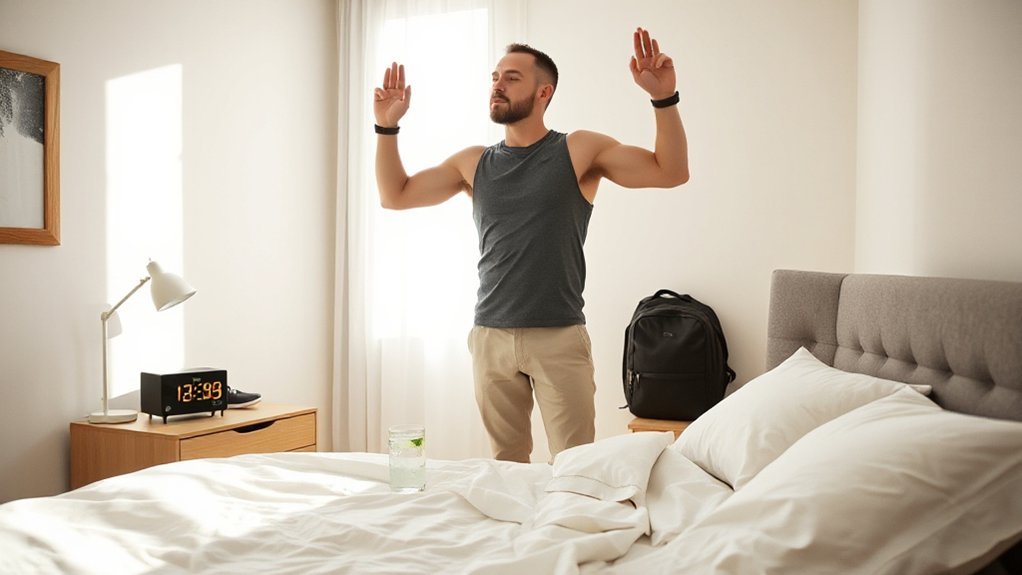
Although your daily demands may fluctuate, you should keep consistent bed and wake times because your circadian clock responds to regular timing; clinical studies show fixed sleep schedules improve sleep efficiency, reduce latency, and enhance daytime alertness. You’ll set limits on sleep variability by prioritizing weekday consistency and minimizing weekend shifts, which preserves phase stability. Tailor timing to your chronotype alignment — advance or delay schedules in 15 to 30 minute steps over several days to avoid abrupt phase shifts. Monitor outcomes objectively: track total sleep time, sleep latency, and daytime sleepiness with validated scales. If persistent impairment occurs despite adherence, evaluate for sleep disorders or medication effects. Implementing a structured schedule yields measurable gains in sleep quality and daytime performance. Maintain clinical oversight.
Get Bright Light Within 30 Minutes of Waking

Because your circadian system is most responsive shortly after awakening, getting bright light within 30 minutes reliably shifts your internal clock, suppresses residual melatonin, and boosts morning alertness. You should expose yourself to high-intensity natural light or a clinically validated light box for 20–30 minutes; these interventions produce measurable improvements in vigilance, mood, and cognitive performance. Consider dawn simulation if early wake times or seasonal low light make immediate outdoor exposure impractical—controlled ramping light mimics sunrise and facilitates circadian entrainment. Use devices that deliver 2,500–10,000 lux at eye level, position lights correctly, and avoid screens before exposure. If you take medications or have ocular disease, consult a clinician to tailor timing and intensity. Consistent morning light produces durable phase advances and sustained daytime alertness.
Move Your Body With a Short Morning Routine

Mobilizing your body with a brief, structured morning routine reliably jump-starts alertness and metabolic readiness. You should perform a focused 8–12 minute sequence combining Dynamic Stretching with a short Bodyweight Circuit to elevate heart rate, increase blood flow, and prime neuromuscular function. Use controlled tempo, 30–45 seconds per exercise, and prioritize compound movements that map to your daily tasks. Measure perceived exertion; aim for moderate intensity so you stay energized rather than fatigued. Keep technique strict to reduce injury risk.
- Hip openers and leg swings (Dynamic Stretching)
- Push-ups, bodyweight squats, plank switches (Bodyweight Circuit)
- Controlled breathing and posture checks
Repeat 2–3 cycles; adjust volume to fitness level and schedule. Track progress weekly to refine intensity, volume, and movement selection based on recovery and outcomes.
Rehydrate Immediately After Getting Up
After 6–8 hours without fluids, you’re typically mildly dehydrated, which can reduce blood volume, impair cognitive function, and blunt morning metabolic rate—so drink water right after you get up.
| Action | Rationale |
|---|---|
| Drink 300–500 ml | Restore plasma volume |
| Check water quality | Avoid contaminants |
| Add electrolytes if needed | Maintain electrolyte balance |
| Monitor urine color | Objective hydration marker |
Start with 300–500 ml of filtered water to restore plasma volume, support electrolyte balance, and stimulate metabolism. If you sweat heavily, add a pinch of salt or a balanced oral electrolyte solution to replace sodium and potassium. Sip steadily over 15–30 minutes; avoid large cold volumes that can provoke gastric discomfort. Consistent morning rehydration improves alertness, cardiovascular performance, and cognitive speed. Track intake daily to optimize individual hydration needs.
Time Your Caffeine for Maximum Benefit
When should you take your morning coffee to get the biggest boost? You should delay caffeine until mid-morning (about 60–90 minutes after waking) to align with declining cortisol, maximizing alertness. Consider caffeine half life — typically 3–5 hours — when scheduling doses to avoid late-day interference. Genetic differences affect metabolism: slow metabolizers may need lower or earlier intake. Use data-driven timing rather than habit.
- Delay first cup 60–90 minutes after waking for synergy with cortisol rhythm.
- Limit total intake and note caffeine half life to prevent accumulated effects.
- Adjust timing and dose based on genetic differences and observed sleep impact.
Track performance and sleep, and consult a clinician for personalized guidance. Small experimental trials support improved vigilance with timed intake, but large trials are limited. Use caution.
Optimize Your Bedroom for Better Sleep
You’ll get better sleep when your bedroom is cool and dark, which reinforces core sleep physiology. Choose a supportive mattress and pillows that preserve spinal alignment and minimize nocturnal arousals. Don’t keep electronic devices or bright lights in the room, since blue light and notifications disrupt circadian signaling.
Cool, Dark Environment
Because core body temperature and melatonin secretion drive sleep onset and quality, keep your bedroom cool and dark to reliably improve restorative sleep. You should target 60–67°F, seal window drafts, and address excess humidity common in basement bedrooms to maintain thermoregulation and melatonin production. Use blackout curtains and avoid light-emitting devices; even small light reduces melatonin. Implement consistent airflow and consider a quiet fan for white-noise and circulation without raising temperature. Monitor with a simple thermometer and hygrometer. Practical, low-cost measures produce measurable improvements in sleep efficiency and morning alertness. These strategies are supported by sleep physiology and clinical studies consistently in men.
- Seal window drafts and insulate gaps.
- Install blackout curtains or shades.
- Use a fan or ventilation to stabilize temperature and humidity.
Comfortable Mattress and Pillows
If you sleep on a mattress or pillow that doesn’t support neutral spinal alignment and relieve pressure points, you’ll fragment sleep and wake with stiffness and fatigue; clinical studies link proper mattress firmness and pillow height to reduced pain, fewer nocturnal awakenings, and improved sleep efficiency. Choose a mattress that provides consistent pressure relief across shoulders and hips; medium-firm often balances support and cushioning for many men, but individual testing matters. Match pillow height to your sleep position to preserve cervical alignment. Evaluate edge support for full-surface stability if you sit or sleep near the mattress perimeter. Replace bedding when indentations or loss of resilience exceed clinical thresholds. Prioritize measurable support metrics and trial periods rather than marketing claims to optimize restorative sleep daily.
Limit Electronics and Light
Proper mattress support helps reduce sleep fragmentation, but controlling light and electronic stimulation completes the sleep environment. You should remove screens and enforce limits before bed:
- Avoid bedside charging and relocate chargers outside the bedroom.
- Use blackout curtains and dim warm lighting to minimize retinal stimulation.
- Enable Do Not Disturb and rigorous notification management for sleep hours.
Blue light and micro-arousals from alerts suppress melatonin and fragment slow-wave sleep, reducing morning alertness. Implementing darkness, removed bedside charging, and strict notification management consolidates sleep and improves morning energy, cognition, and mood. Adopt these changes and track outcomes daily. Track sleep duration and quality with objective measures, adjust evening routines based on data, and consult a clinician if persistent insomnia or daytime impairment continues for evaluation.
Wind Down the Night Before With Simple Habits
To support restorative sleep and next-day energy, you should limit evening screen exposure and set a consistent bedtime—both are reliably linked to improved sleep continuity. Aim to stop screens at least 60 minutes before bed and keep your sleep timing within a 30–60 minute window nightly, aligning behavior with circadian and melatonin regulation. Add brief pre-sleep relaxation rituals—diaphragmatic breathing, light stretching, or quiet reading—to lower physiological arousal and speed sleep onset.
Limit Screen Time
Because blue light and evening stimulation suppress melatonin and raise arousal, you should stop intentional screen use about 60–90 minutes before bed. Turn off work notifications, enforce work boundaries, and avoid doomscrolling; these steps reduce cognitive activation and improve sleep onset. Replace screens with low-arousal, nonstimulating activities that cue relaxation. Use wind-down routines, example:
- Read printed book
- Do light stretching or mobility
- Practice mindful breathing exercises
Use simple environmental controls: dim lights, activate night mode earlier, and charge devices outside your bedroom to reduce temptations. If you need wind-down activities, choose replacement hobbies that are tactile and low-stimulus. Evidence indicates reduced screen exposure improves sleep efficiency and subjective morning alertness. Monitor changes for two weeks and track perceived energy each morning.
Set a Consistent Bedtime
If you set a consistent bedtime and follow simple pre‑sleep habits, you’ll reinforce your circadian rhythm, reduce night‑to‑night sleep variability, and boost next‑morning alertness. Establish a fixed lights‑out time and treat it as nonnegotiable; your body adapts when sleep schedule cues are stable. Track adherence for routine accountability—use a sleep log or app to monitor deviations and adjust exposure to daytime cues like light and activity. Create small bedtime incentives to increase adherence: schedule a preferred low-stimulation activity earlier, reward meeting weekly targets, or pair wind‑down with social commitments that anchor timing. Expect measurable improvements in sleep latency and sleep efficiency within weeks. If shift work or travel disrupts timing, prioritize rapid re‑establishment of the fixed bedtime to restore rhythm. Maintain consistency for health.
Pre-sleep Relaxation Rituals
When you adopt a brief, consistent pre‑sleep relaxation ritual, you lower physiological arousal and prime your nervous system for sleep: studies show that routines combining reduced screen exposure, quieting activities, and simple breathing or progressive muscle relaxation decrease sympathetic activity, reduce cortisol and heart rate, and shorten sleep latency. Use 20–30 minutes nightly to cue sleep: dim lights, stop screens, and choose one evidence-based technique.
- Guided visualization to reduce cognitive arousal.
- Progressive muscle relaxation to lower muscle tension.
- Short aroma massage or inhalation to enhance parasympathetic response.
You can practice guided visualization to shift attention from stressors, or perform progressive muscle relaxation. Consider an aroma massage or inhalation of calming scents as an adjunct; avoid stimulants. Track response, adjust timing, and maintain consistency.






Leave a Comment