

You can reset your sleep schedule in a week by treating sleep timing like a circadian prescription. Pick a fixed wake time, expose yourself to bright morning light within 30 minutes, and move bedtime earlier by 30–60 minutes each night while avoiding late caffeine and screens. Follow consistent daytime cues and a short wind‑down routine, and you’ll notice measurable shifts—here’s how to implement it step by step.
Why Your Sleep Schedule Is Messed Up
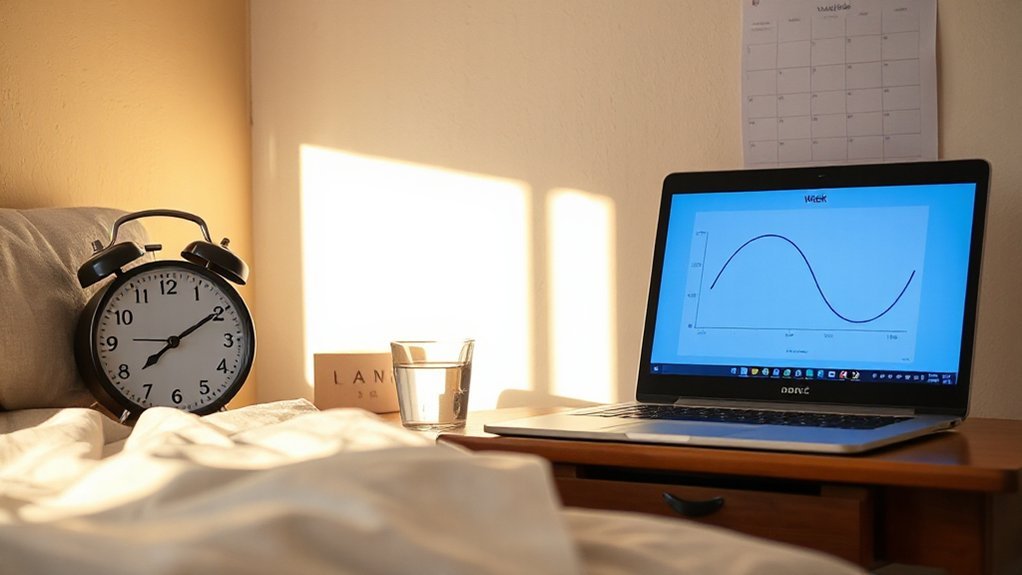
Because your internal clock depends on consistent cues, irregular sleep timing, nighttime light, and late stimulants quickly shift circadian phase and fragment sleep, leaving you tired at the wrong times. You’re experiencing circadian misalignment when your biological night and social schedule disagree, so sleep onset, depth, and wake timing degrade. Nighttime light and evening caffeine delay melatonin and reduce slow-wave sleep; shift work, variable bedtimes, and weekend sleep debt create social jetlag that repeats weekly. That mismatch impairs daytime alertness, mood, metabolic regulation, and cognitive performance. You can measure timing with sleep logs or actigraphy and track daytime sleepiness to guide adjustments. Prioritize consistent daily timing, timed light exposure, and limiting evening stimulants to realign rhythms and consolidate sleep. Expect gradual improvement over weeks.
Set a Realistic Target Sleep Window
Now that you’ve identified how circadian misalignment and behavior disrupt sleep, set a realistic target sleep window that matches your biological needs and daily obligations. Decide on a fixed bedtime and wake time that align with your chronotype matching while respecting social constraints like work, commuting, and caregiving. Use objective markers—daily sleepiness, melatonin onset estimate from consistent evening dim-light exposure, and 7–9 hour need—to test feasibility. Prioritize consistent wake time; allow +/-30 minutes for bedtime. Track two weeks of logs to confirm practicality and adjust gradually if needed.
- Choose window based on habitual sleepiness peaks
- Align wake time with unavoidable social constraints
- Restrict bedtime variability to 30–60 minutes
- Use objective logs and light exposure to validate
Reassess target after two weeks of consistent implementation.
One-Week Step-by-Step Reset Plan

When you follow a tightly structured seven-day protocol, you’ll begin to shift your circadian phase and consolidate sleep by combining timed light exposure, consistent wake times, and simple behavioral controls. Day 1: set target sleep window and wake time; expose yourself to bright morning light and avoid naps. Day 2–3: advance bedtime 30–60 minutes if needed; maintain fixed wake time; use minimal evening light. Day 4–5: assess progress checkpoints—sleep latency, total sleep time, daytime alertness—and adjust bedtimes in 15–30 minute steps. Day 6: stabilize target window; simulate workday wake schedule. Day 7: review data with an accountability partner, confirm sustained timing, and plan gradual maintenance. Track outcomes with a sleep diary and actigraphy.
Daily Habits to Support Better Sleep
Keep a consistent wake time every day, even on weekends, because it strengthens your circadian rhythm and improves sleep quality. Establish a 30–60 minute evening wind-down routine that limits bright light, reduces stimulation, and promotes relaxation. When you combine these habits, you’ll support sleep onset and maintenance and increase the likelihood the reset plan succeeds.
Consistent Wake Time
In the morning, waking at the same clock time every day anchors the circadian rhythm and improves sleep consolidation. Maintain a fixed wake time on weekends to stabilize melatonin onset and sleep efficiency. Align wake time with workshift synchronization and family routines to reduce social jetlag; when shifts vary, choose a consistent baseline and adjust gradually. Use light exposure within 30 minutes of waking to phase-advance circadian timing. Limit naps to under 20 minutes and avoid late-day naps that fragment sleep. Track sleep timing for one week and adjust by 15–30 minutes per day if needed.
- Set a target wake time and commit.
- Coordinate with household schedules.
- Use morning bright light therapy when indicated.
- Record and review daily wake times.
Evening Wind Down
Although winding down looks different for everyone, you should establish a predictable pre-sleep routine that signals your body to ease into sleep, since consistent cues improve sleep onset and efficiency. In the evening, dim lights and stop screens 60–90 minutes before bed to reduce blue light and arousal. Choose a light pre sleep snack with protein and low sugar if hunger disrupts sleep; avoid heavy, spicy meals. Practice 10–20 minutes of relaxation: diaphragmatic breathing, progressive muscle relaxation, or brief mindfulness to lower sympathetic tone. Use audio stories or low-volume guided meditations to mask intrusive thoughts and promote habituation to sleep cues. Keep the environment cool, dark, and quiet. Consistency matters: perform the same sequence nightly to reinforce circadian and homeostatic signals. Track progress objectively.
Quick Environmental and Light Hacks
How can you shift your circadian phase quickly with minimal effort? Use targeted light and environmental changes supported by evidence. In the morning get high-intensity blue-enriched light or a Dawn simulator to advance wake time; increase outdoor exposure within 30 to 60 minutes of waking. In the evening reduce blue light by lowering color temperature and dimming lights to signal melatonin onset. Control bedroom cues: cool temperature, blackout curtains, and remove electronic screens. Keep interventions consistent each day. These steps have clinical rationale and data.
- Use a dawn simulator set to warm, gradual light.
- Get 10 to 30 minutes of bright outdoor light early.
- Switch lamps to warm bulbs; lower color temperature after sunset.
- Maintain bedroom coolness (about 18 to 20°C) and full darkness.
Managing Setbacks and Staying Consistent
Setbacks—like late nights, travel, illness, or social obligations—are common and don’t mean your progress has failed; you can regain ground quickly by re-establishing consistent cues and a clear plan. You should use relapse planning: identify likely triggers, set pre-decided corrective actions, and prioritize sleep opportunity over perfect timing. Use habit tracking daily to monitor wake time, bedtime, light exposure, and naps. Brief reviews reduce drift and support adherence. Keep corrective measures simple: short naps under 30 minutes, morning light exposure, and no caffeine after midday. Use the table below to standardize responses and review frequency.
| Trigger | Immediate action | Review interval |
|---|---|---|
| Late night | Morning light, earlier bedtime | Daily |
| Travel | Fixed wake time, adapt local light | After arrival |
| Illness | Prioritize rest, shift gradually | Every 48h” |






Leave a Comment