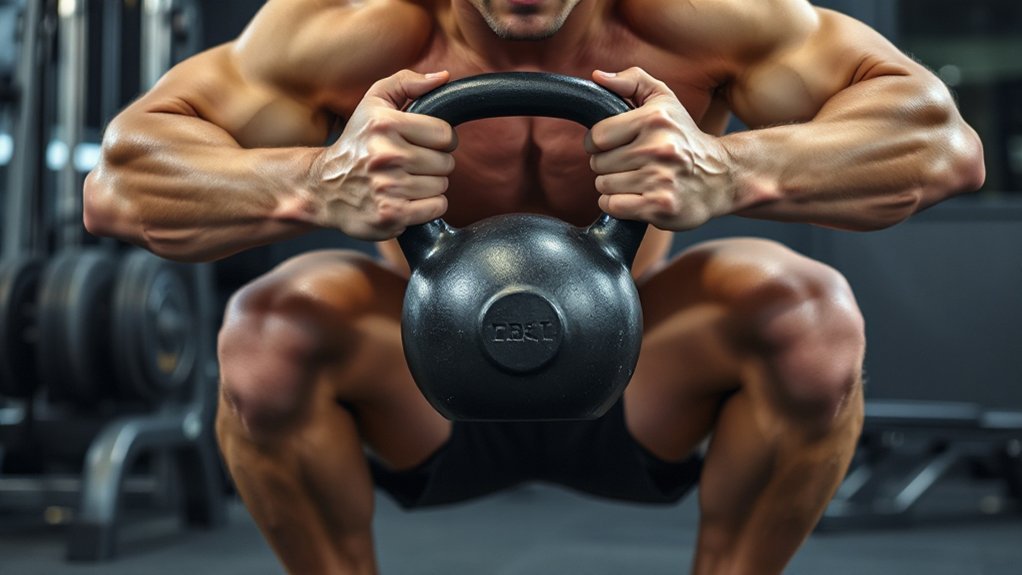

A goblet squat’s your go-to move: hold a dumbbell or kettlebell at chest height, then squat down. The weight shifts your center forward, forcing your torso upright—which means less spinal stress than barbell squats and way more quad work. Your core braces hard, your knees track clean, and you’ll nail your mechanics faster. Whether you’re a beginner learning the pattern or advanced and chasing volume, it’s brutally effective. Stick around to discover how to fix common mistakes and customize your stance.
Key Takeaways
- Front-loaded squat holding weight at chest that keeps torso upright and reduces spinal compression compared to back squats.
- Shifts center of mass forward, increasing quadriceps demand while requiring greater core and upper-back bracing for stability.
- Ideal for beginners to learn proper squat mechanics, improve ankle mobility, and develop knee tracking with minimal equipment.
- Common faults include chest collapse, heel lift, and knee caving; corrected by bracing core, elevating heels, and driving knees outward.
- Program as primary lift (3–4 sets, 8–12 reps), warm-up, or conditioning circuit; progress by slowing descent or adding bottom pause.
What Is a Goblet Squat and Why It Works
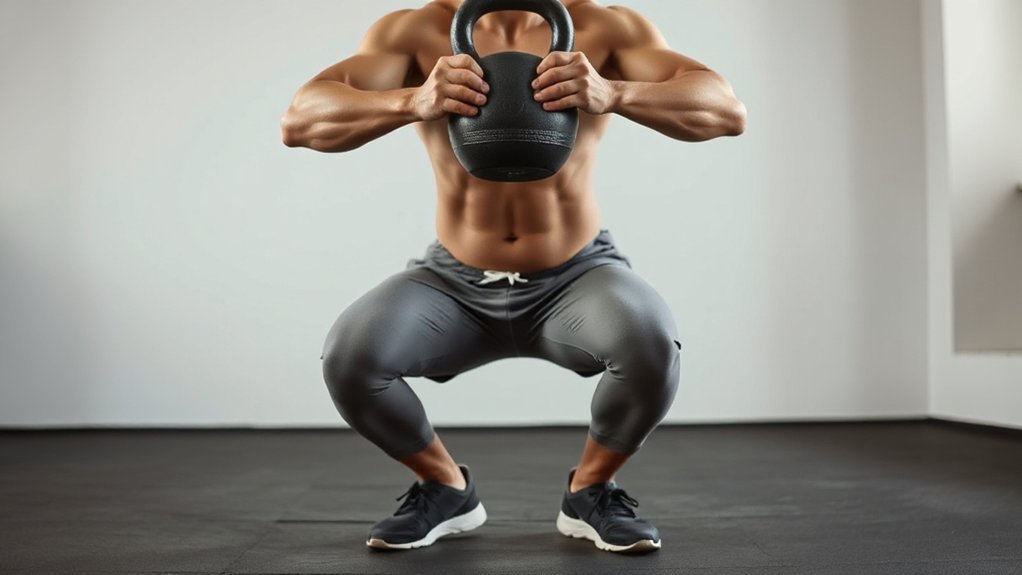
If you’ve ever wondered why some people swear by holding a dumbbell or kettlebell at chest height while squatting instead of loading a barbell across their back, there’s solid reasoning behind it. A goblet squat does something clever: it shifts your center of mass forward, forcing your torso to stay upright and hammering your quads harder than traditional back squats. Your core and upper back work overtime, bracing against that front-loaded weight to keep your spine neutral and prevent you from folding forward. Here’s the payoff—you get lower spinal compression and shear forces, which means less stress on your lower back. That’s why goblet squats shine for learning proper mechanics, boosting ankle mobility, and nailing knee tracking. You can scale them easily, too. Start bodyweight, progress to a dumbbell, then advance to heavier loads. They’re accessible, effective, and genuinely safer than jumping straight into loaded barbell work.
How to Perform Goblet Squats With Proper Form
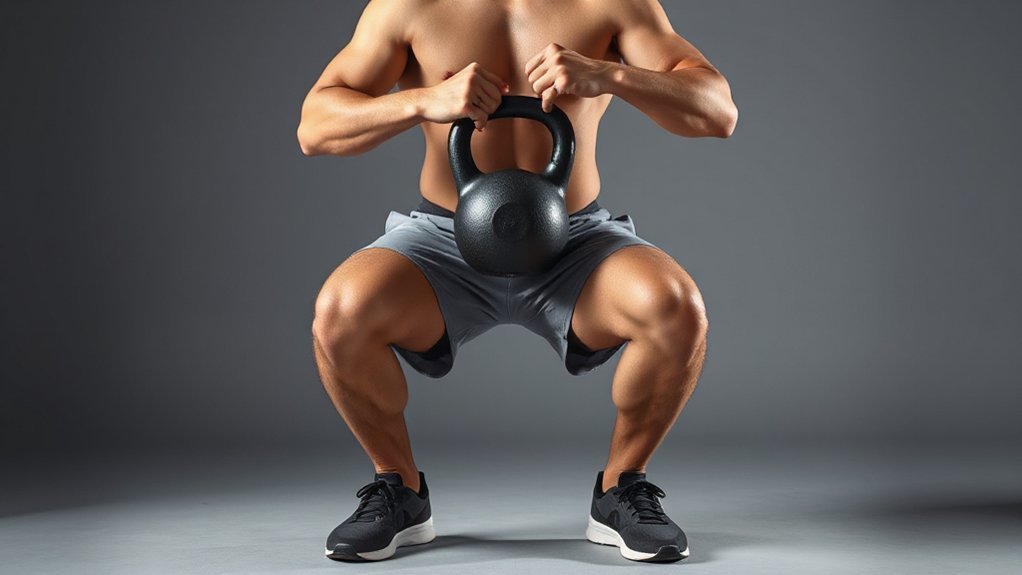
Nailing goblet squat form starts with how you hold the weight—and yeah, it matters more than you’d think. Cup that dumbbell or kettlebell vertically at chest level with both hands, elbows tucked tight to your sides. Keep the weight close to your sternum; this keeps your torso upright and honest.
Cup the weight at chest level with both hands, elbows tucked tight—how you hold it matters more than you’d think.
Next, position your feet shoulder-width apart (or slightly wider), toes turned out 10–30° based on what your hips allow. Brace your core with a deep belly breath before descending.
Now the descent: push your hips back and bend your knees together, lowering until your thighs hit parallel to the floor. Chest stays up, spine neutral, elbows tracking between or just inside your knees. Drive back up by pressing through your heels and midfoot, fully engaging those glutes.
Heels lifting? Knees caving inward? Lower back rounding? Reduce depth, widen your stance, or elevate those heels on a small plate.
Fix Common Form Mistakes
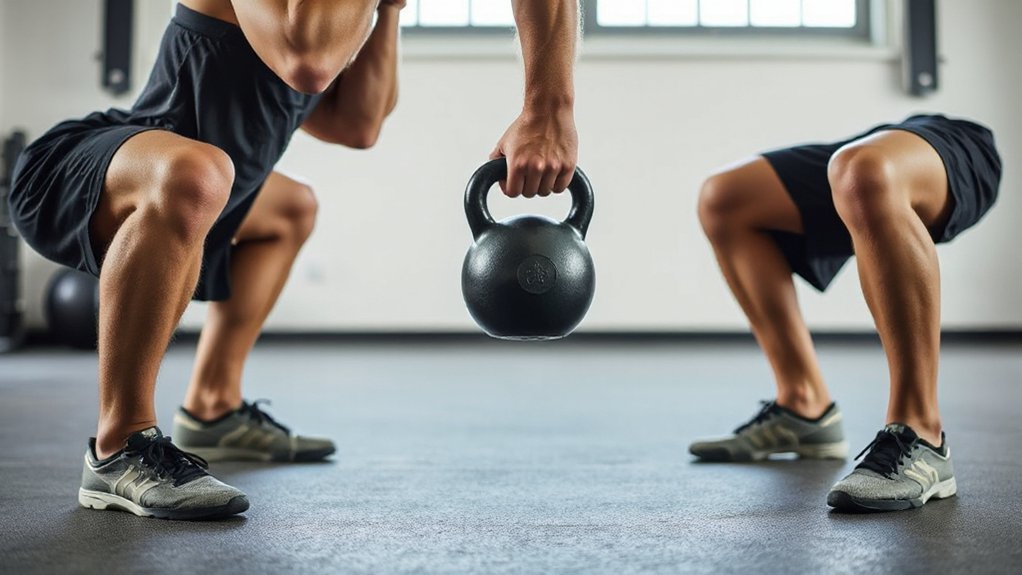
Even solid lifters slip up in the squat—chest caves, heels pop up, knees drift inward, and suddenly you’re wondering what went wrong.
Here’s the thing: these hiccups are fixable. When your chest collapses forward, brace your core, keep the dumbbell tight to your sternum, and sit back into your hips. Imagine your back pockets moving straight toward your heels—this keeps your torso upright where it belongs.
Heels lifting? Elevate them 1–2 inches on a small plate or widen your stance slightly. That simple shift reduces ankle demand and enables deeper depth.
Knees caving inward? Drive your elbows between them at the bottom, actively pushing your knees to track over your second toe.
Experiencing a butt-wink? Shorten your range, work on hip mobility, and maintain core tension instead of forcing depth.
For wrist or elbow pain, try a thumbless grip, cradle the weight against your chest, or switch to two dumbbells. Problem solved.
Stance, Equipment, and Elevation Variations
Once you’ve locked down solid form and crushed those common mistakes, it’s time to play with the variables that’ll make the goblet squat work *for your body*—not against it.
Your stance is your foundation. Here’s what shifts the work around:
- Standard stance (shoulder-width, toes out 10–30°) balances quad and glute engagement while keeping your knees tracking safely over your toes.
- Narrow stance cranks up quad and core demand, though you’ll need more ankle mobility to hit depth comfortably.
- Wide sumo stance (toes around 45°) leans harder into your glutes and inner thighs, making depth feel easier on most people.
- Heel elevation (a half-inch to two-inch wedge) reduces ankle flexibility requirements and shifts emphasis toward your quads while keeping your torso more upright.
Experiment. Your grip—dumbbell, kettlebell, or medicine ball—doesn’t change the mechanics; it just changes comfort. Always drive through your whole foot: big toe, little toe, heel. That’s your tripod. That’s your power.
Programming Goblet Squats Into Your Routine
Where do goblet squats fit into your actual training week? Honestly, they’re incredibly versatile. As a beginner’s primary lower-body lift, use them for 3–4 sets of 8–12 reps, emphasizing slow descents and perfect form. Already strong? Program them post-heavy compounds—2–4 sets of 10–20 reps add volume without crushing your spine. Or use them as a warm-up, 2–3 sets of 6–10 reps, to nail your squat mechanics before hitting the barbell.
Progress smart. Once you’ve nailed target reps with strict form, bump up the weight. No heavier dumbbells available? Add a 3-second descent or pause at the bottom—same difficulty, same gains.
Limited ankle mobility? Elevate your heels or shorten your range temporarily while you drill mobility work on the side. Need conditioning? Throw them into circuits: 8–12 reps every minute for 8–12 minutes. They’re your technical checkpoint, too.
Frequently Asked Questions
Can Goblet Squats Replace Barbell Squats in a Strength Training Program?
Not entirely, honestly. Goblet squats build solid leg strength and mobility, but they cap out—your arms tire before your legs do. For serious strength gains, you’ll need barbell squats’ heavier loads. That said, goblets excel as accessory work or warm-ups. They’re gentler on your spine too. Think of them as partners, not replacements. Stack both into your program for balanced, durable strength.
How Much Weight Should Beginners Start With for Goblet Squats?
Studies show that 70% of beginners struggle with form before load—so you’re not alone. Start light, maybe 15-25 pounds, and focus on nailing your technique first. You’ll feel the difference between sloppy reps and quality ones. Once you’ve got solid form down—chest up, knees tracking straight, full depth—gradually bump the weight up. Listen to your body, not your ego. You’ve got this.
What’s the Ideal Rest Period Between Goblet Squat Sets?
You’ll want to rest between 60 to 90 seconds between sets—maybe 2 minutes if you’re pushing heavier weight. Here’s the thing: you’re not training for powerlifting here, so shorter rests actually work in your favor. They keep your heart rate up, torch calories, and build work capacity. Listen to your body though. If you’re gasping and can’t maintain form, take that extra breath. Quality matters more than speed.
Are Goblet Squats Effective for Building Muscle Mass and Strength?
You’re basically holding a golden ticket to strength gains. Goblet squats? They’re a powerhouse for building muscle and strength, especially in your quads, glutes, and core. The weight forces your muscles to work hard, triggering real growth. You’ll notice improvements in functional strength too—climbing stairs becomes easier. They’re not flashy, but they’re genuinely effective. Progressive overload matters here: gradually increase weight, and you’ll see solid results.
Can Goblet Squats Help Improve Athletic Performance in Sports?
You’ll absolutely see athletic gains here. Goblet squats build explosive leg power, boost your balance, and strengthen your core—all essential for sprinting, jumping, and cutting movements in sports. The front-loaded weight mimics real athletic demands, so your body adapts practically. You’re training functional strength that directly transfers to performance. Start with moderate weight, nail your form, then progress steadily. That’s how you access tangible athletic advantages.
So
You’ve now learned that holding a kettlebell—ironically, the simplest tool in the gym—unlocks serious lower-body gains. Who knew that adding weight to your chest’d transform your squat? You’re ready to load up, nail that form, and crush your goals. Start light, own the movement, then progress. That’s it. You’ve got this. Your legs won’t know what hit ’em.





Leave a Comment